How to spot a moving scam before your furniture is on the truck.
A moving scam rarely starts with a threat. It starts with a great price — hundreds, sometimes thousands below everyone else. The trap only becomes visible on moving day, when your goods are loaded and the price changes. This guide shows you how the trap works, the red flags to spot before you sign, and the one piece of math that stops the most common version of it: cubic feet.
If a price is based on numbers you cannot verify — an inventory you never saw, cubic feet you never checked, or a contract you signed blank — do not let the truck be loaded. Once your goods are on board, your leverage is gone.
How the scam actually starts — on Google, not on moving day
By the time a truck shows up at your door, the scam has usually been running for weeks. It starts earlier — with a polished website and a search you made in a hurry.
A clever website is not proof of a real company
Scam operations invest in websites that look more professional than many legitimate movers: clean design, smiling crews in stock photos, five-star reviews, "licensed & insured" badges, and a fast online quote form. None of that is hard to buy. A good-looking website tells you someone spent money on marketing — it tells you nothing about whether they own a truck, hold a valid USDOT registration, or will honor the price on your screen.
Then they make sure you find that website first. Brokers and lead generators spend a fortune bidding on the exact phrases people type when they need a mover, right now:
Those searches are heavily trafficked — and heavily bought. The companies at the top of the results are often there because they paid the most for the click, not because Google checked their license.
What a bad address looks like
When you do check the address, walk away — or dig a lot deeper — if you find any of these:
- No real address at all — a contact form and a phone number, but no street address anywhere on the site or paperwork.
- Only a P.O. Box. A mailbox is not a place trucks are parked or an office anyone works from.
- A vacant lot — the map or Street View shows empty land, a parking lot, or a building that isn't theirs.
- A mailbox store — the "suite" turns out to be a UPS Store, a pack-and-ship shop, or a virtual-office address.
- Someone else's business — the address belongs to a completely different company that has never heard of them.
Search differently: start with the address
Instead of searching "movers near me," search for companies you can pin to a place:
Get the physical address
Before you ask for a price, get the company's full street address — the actual location, not a P.O. Box. If they won't give one, that's your answer.
Match it against the FMCSA SAFER record
Look the company up yourself in the SAFER Company Snapshot — search by USDOT number first; it's the cleanest match. The address on the federal record should match the address they gave you and the one on your paperwork. A mismatch — or no record at all — is a stop sign. The full how-to is in Protect yourself before you book below.
Put the address on a map
Drop the same address into a map and look at what's actually there — satellite and Street View. You're confirming a real moving business sits at that spot, not a vacant lot, a mailbox store, or someone else's shop.
How the trap works
Most moving scams follow the same five stages. Recognizing the stage you're in is what lets you stop it early — while stopping is still free.
The low quote
You get a fast estimate over the phone or online, often without anyone seeing your home or belongings. The price is well below other quotes — and may be priced by cubic feet rather than weight, which makes it easy to inflate later.
The easy booking
You're asked for a deposit — sometimes a large one, sometimes by cash, wire, or payment app — and sent paperwork to sign quickly. The inventory list, if there is one, is vague or much shorter than what you actually own.
The company changes
The broker who sold you the move is not the company that shows up. A different name is on the truck, the paperwork, or both. Each company later blames the other for the price and the promises.
The price changes on loading day
After some or all of your goods are loaded, you're told you have more cubic feet, more weight, or more items than estimated. The new price can be double or triple the quote — and refusing feels impossible because your belongings are already on the truck.
The hostage load
Delivery is delayed, storage or redelivery fees appear, and your goods are withheld until you pay the new amount — often in cash or by wire before unloading. Paying under pressure, without paperwork, makes recovery much harder.
Broker or carrier — know who you hired
A carrier owns trucks and moves your goods itself. A broker sells the job and arranges for a carrier to do it. Brokers are legal, but scam operations use the split to dodge responsibility. Ask directly:
"Are you a broker or a carrier? Who will actually pick up my goods, and what is that company's legal name and USDOT number?"
Get the answer in writing.
Red flags: how to identify a scam mover
One flag can be a misunderstanding. Two or more together are a pattern. Walk away when you see several of these.
Before you book
- No survey of your belongings. No in-home visit and no live video survey, yet a firm-sounding price.
- A price far below every other quote for the same inventory and dates, with no clear explanation.
- Pricing by cubic feet alone, with no itemized inventory showing a cubic-foot figure per item.
- A large deposit demanded up front, especially in cash, by wire, or by payment app.
- No USDOT number, no physical local address, or a name that doesn't match its federal registration.
- A brand-new or generic name resembling a famous mover's, with reviews that all appeared at once.
- Pressure to book today because "trucks are almost gone," paired with reluctance to put promises in writing.
In the paperwork
- Blank or partly blank contracts you're asked to sign, with prices or inventory "to be filled in later." Never sign one.
- No type of estimate stated. It should say clearly: binding, binding not-to-exceed, or non-binding.
- An inventory that omits items you listed, or lists volumes that don't match the furniture in your home.
- No valuation and liability information, and no copy — or link — for the federal booklet Your Rights and Responsibilities When You Move for an interstate move. You are owed it before you sign — see the booklet section below. And if valuation is glossed over, or you're defaulted to Released Value without an explanation, that's a red flag too — see the valuation section below.
- Refuses to show its published tariff, or hits you with charges that don't appear in it. By law the tariff must be made available to you on request — see the tariff section below.
- Can't name its arbitration program. An interstate mover is required to offer arbitration for loss and damage claims — if it can't tell you what its program is or how to start a claim, that's a red flag. See the arbitration section below.
On moving day
- A truck with no permanent markings, a different company name than you hired, or a rental truck presented without explanation.
- A new price after loading has started, based on cubic feet or items you cannot verify.
- A weighing you weren't told about. On a weight-priced move, the mover must tell you where and when each weighing will occur and give you a chance to observe it — and must produce signed weight tickets. See the weighing section below.
- A demand for cash or wire before delivery for an amount above what the estimate allows.
Protect yourself before you book
Verify the company
- Look up the mover's USDOT number with the FMCSA. Confirm legal name, address, registration status, and whether it's registered as broker, carrier, or both.
- Check complaints for that exact USDOT number and legal name — not just the brand name on the website.
- Confirm the phone and address on the contract match the registration.
- Get at least three estimates for the same inventory, dates, and services, so an outlier price is visible as an outlier.
Get the right kind of estimate
- Insist on an in-home or live video survey. A phone-only description invites a low quote that cannot hold.
- Ask for a binding or binding not-to-exceed estimate in writing — you pay the quoted price or the actual lower price, not more.
- Demand an itemized inventory with a cubic-foot figure for each item if pricing is by volume. Check it against your rooms before you sign.
- Make sure added charges are named in the estimate: stairs, long carry, shuttle, packing, storage, fuel.
Protect your money & paperwork
- Keep any deposit modest, pay by credit card where possible, and never pay the full balance before delivery.
- Never sign a blank document. Cross out empty fields or write "none" before signing.
- Keep copies of everything — estimate, inventory, contract, valuation choice, receipts — photographed on your phone as well as on paper.
- Understand valuation before moving day, and make the choice in writing on the Bill of Lading / order for service. Released Value pays just $0.60 per pound per article on an interstate move; Full Value Protection costs a premium but pays repair or replacement value. See the valuation section below.
Verify the company yourself — in FMCSA SAFER
Don't take the company's word for its own registration. The SAFER Company Snapshot is the federal record for every mover and broker — free, and it takes two minutes:
Check a company in FMCSA SAFER — https://safer.fmcsa.dot.gov/CompanySnapshot.aspxHow to search
- Search by USDOT number first. That is the cleanest way to find the right record — company names can be similar to each other, or deliberately cloned to look like a real mover's name.
- If you don't have the USDOT number, search by MC/MX number or by company name instead — then confirm the record you land on is really this company, using the checks on the right.
What to check on the snapshot
- Legal name — matches what the company told you and what is on your paperwork
- Physical address — the same real street address in all three places
- Phone number — the number on the federal record is the company you think it is
- Operating status — active, and authorized for household goods
- Broker or carrier — registered as what the company claims to be: a broker arranges moves, a carrier performs them
If any of these don't match what the company told you or what is on your paperwork, stop and get an explanation in writing — before anything is loaded. A cloned or borrowed identity falls apart right here.
Moving across state lines? The FMCSA's own consumer guide covers your rights on an interstate move: FMCSA Protect Your Move →
Ask for referrals — don't stop at Google reviews
Google reviews are where most people start — and where scam movers work hardest to look trustworthy. Read them, but don't hire on them alone. Before you book anyone, ask real people who actually moved: a realtor, a friend, your community, and your local community pages on Facebook.
A star rating can't answer back
A review page is easy to game, and a scam operation knows it:
- Reviews can be bought. Five-star reviews are sold in batches — a new company can look established in a week.
- Reviews can be faked. The same operation can post under different names, for companies it controls, in towns it has never worked in.
- Reviews can be flooded. A burst of glowing reviews buries the real complaints underneath — especially when they all land at once, in the same wording.
- You can't ask a review a question. No follow-up, no "what did you actually pay?" — just a score you have to take on faith.
A person you can actually talk to
A referral is not a score. It's someone who lived through that move and can tell you, in detail:
- The price — what they were quoted, and what they actually paid in the end. Did it change on the day?
- The crew — who showed up, whether it was the company they hired, and how those movers treated their home and furniture.
- The delivery — whether it arrived when promised, complete, and in the condition it left in.
- Whether the company kept its promises — especially when something went wrong, because that's when a mover shows you who it is.
Realtors
Realtors watch clients move in and out every week. They hear — immediately — who showed up on time, who changed the price at the door, and who their clients swore they'd never use again.
They also put their own name on the line when they recommend someone, so a good realtor doesn't hand out a mover's name casually. If you're buying, selling, or renting, your agent is the single best referral to ask for first.
Friends, family & coworkers
Someone you know who moved in the last year or two has no reason to sell you anything. They'll tell you the parts no review mentions — the surprise fees, the wait for delivery, how a damage claim was handled.
Ask for a name that comes from an actual move, not one they just heard of. "Who moved you?" is a much stronger question than "do you know a mover?"
Your community & your neighbors
The people around you move with the same local companies you're about to hire. Neighbors on your street, people in your building, your HOA or building manager, coworkers in the same town — someone nearby used a mover recently.
Local word of mouth is hard for a scam operation to fake. A company that burns people in one neighborhood gets talked about in that neighborhood.
Community pages on Facebook
Post in your town or city's community page, neighborhood groups, and local parent and community groups — and in moving-awareness groups, where victims name the companies that burned them.
You'll usually get two things at once: names people trust, and warnings. In a local group, real members answer with their own moves — and a company with a pattern gets called out by name, fast.
Don't just collect a name — ask these six questions
A referral only helps if you ask what the move was really like. Whoever recommends a mover — realtor, friend, neighbor, or someone in a Facebook group — ask:
- What were you quoted — and what did you pay in the end? If the two numbers match, that's the strongest sign there is.
- Who showed up on the day? Was it the company you hired, or a different name on the truck?
- How was the crew? On time, careful with the furniture and the walls, professional to deal with?
- How was delivery? On the date promised, everything there, anything damaged or missing?
- Did they keep their promises? When plans changed or something went wrong, did the company fix it — or disappear?
- Would you hire them again? A yes without hesitation means more than fifty five-star reviews.
Your right to an in-home visual estimate — and what it reveals
If a moving company is within a 50-mile radius of your house, you can request an in-home visual estimate: the mover comes to your home, walks through the rooms with you, sees what is actually being moved, and bases the estimate on that — instead of a phone call or an online form where nobody has seen a single item.
Can actually send someone to your home
A genuine mover with a yard, trucks, and a crew near you can do what a visual estimate requires:
- Show up in person — walk room to room, open the garage, and look at the access: stairs, driveway, and how close a truck can get.
- Build the inventory from what they saw — the items, the box count, and the cubic feet are measured from your actual furniture, not guessed from a description.
- Put that estimate in writing — an inventory and cubic-feet total you can check line by line, because both of you were looking at the same rooms.
Pretends to be just around the corner
Most brokers sit far from your home — for example in Florida — while presenting themselves as a moving company just around the corner from you. The in-home request exposes that:
- They have no local crew to send. There is nobody within 50 miles who can walk your home, because the "local mover" is a sales office in another state.
- They can only offer a phone estimate — a price built on your description of your own furniture, which is exactly the guess that gets "corrected" upward on moving day.
- They dodge the question. Vague answers about who would come, or pressure to book now and "survey later," mean the local company in the pitch does not exist.
Ask this, word for word
Before you book, ask: "Are you within 50 miles of my house, and can you send someone for an in-home visual estimate?" A real local mover answers with a date and a name. Anything else — a claim of being local with no one to send, or only a phone estimate on offer — is your answer.
The cubic-feet trick — and how to beat it with math
The scam this stops: a mover quotes you by cubic feet instead of weight, then inflates your inventory on paper. If their number is way above what your stuff would fill in a real truck, the price is padded. Try the calculators — they run the exact math from the guide.
Measure any item yourself
Sofas, beds, wardrobes, desks, appliances — the large items are where inflated figures hide.
Measured in inches? L × W × H, then ÷ 1,728
Worked example from the guide: a sofa at 84″ × 36″ × 36″ = 108,864 ÷ 1,728 = 63 cu ft. If a mover lists that same sofa at 100+ cu ft, ask why — in writing, before you sign.
Total your own boxes
Count your boxes by size. This total, plus your furniture, is the volume a mover should be quoting.
Guide example: 20 medium + 10 large + 4 dish packs + 2 Grand wardrobes = 154 cu ft. If an inventory lists those same boxes at 250 cu ft, the boxes didn't grow — the quote did.
You pay cubic feet per item moved — even when items nest inside each other
On an itemized move, the charge follows each item on the inventory — not just the empty space left on the truck after everything is packed tight. Items that nest, stack, or crisscross each other are still counted per item. Nesting changes how the load fits; it does not erase the items, or the work of moving them.
Five boxes between the legs of a chair
Say you have a chair, and five boxes that all fit neatly in the open space between its legs. On the truck, they take up roughly the footprint of the chair alone — so it can look like the boxes rode for free.
They didn't. You still pay for the chair, and you still pay for each of the five boxes. Just because they fit one inside the other does not mean they do not need to get moved: every box was packed, carried out, loaded, and will be unloaded and carried in at the other end — exactly as if it had sat on its own.
- The chair — charged at its own cubic feet, as one item moved.
- Each box — charged at its own cubic feet, as its own item moved. Five medium boxes, for example, are 5 × 3.0 = 15 cu ft from the box tables in this guide.
- The total — the chair plus all five boxes added together, even though the volumes overlap and crisscross on the truck.
The same applies to anything with open or hollow space — items tucked under a table, inside a wardrobe box, or between the legs and frames of other furniture. The volume of items that nest is still counted per item, not erased by the nesting.
The freezer filled with items
The same logic works in the other direction. If you fill up a freezer with items instead of having them loose, that does save space — the load packs tighter and leaves more room on the truck.
But it creates more work, not less. Every item inside the freezer still has to be:
- Packed and protected individually, so it survives the trip inside the appliance.
- Loaded — placed in, and the filled freezer itself carried and loaded as an item.
- Unloaded and unpacked at destination, item by item, just like loose items.
So the mover is still paid for the work done on each item inside — the space saving is real, but the handling never disappeared.
Don't expect the price to drop just because things nest
If your boxes fit between chair legs, or your goods fill a freezer instead of riding loose, don't expect a discount for the space that was saved. The handling work does not disappear when items nest — each item is still moved, and still charged.
- Judge the per-item figures, not the overlap. The fair question is whether each item's own cubic feet are honest — check them with the cubic-feet math and the box tables.
- Per-item charging is not padding. Padding is inflating an item's size or inventing items. Charging for every real item that was actually moved — nested or not — is how the charge is supposed to work.
The charge follows the item and the work on it
From the mover's side, the charge is not based only on the space left on the truck when everything is nested together. It follows each item moved and the work done on that item.
- Every nested item was still handled — packed, protected, carried, loaded, unloaded, and unpacked.
- Nesting can add work — filling an appliance or tucking items inside other pieces takes more packing and care than loading the same items loose.
- Count items, not gaps. An inventory that lists each item and its cubic feet is the record of what was moved — whether those items ended up side by side or one inside the other.
Truck sizes in cubic feet — judge the quote by the truck that shows up
Take the mover's total cubic feet, find the smallest truck here that would hold it, and ask whether your belongings would really fill that truck floor to ceiling. Capacities below are the figures advertised by each company, as compiled in the guide.
U-Haul
Current sizes page: 10′ = studio/1-bed, 15′ = 1–2 bed, 20′ = 2-bed home, 26′ = 3–4 bed, 29′ = 4–6 bed.
| Truck | Interior | Volume |
|---|---|---|
| Cargo van | 9′6″ × 5′7″ × 4′8″ | 245 cu ft |
| 10′ | 9′11″ × 6′4″ × 6′2″ | 402 cu ft |
| 15′ | 15′ × 7′8″ × 7′2″ | 764 cu ft |
| 20′ | 19′6″ × 7′8″ × 7′2″ | 1,016 cu ft |
| 26′ | 26′2″ × 8′2″ × 8′3″ | 1,682 cu ft |
| 29′ | 29′2″ × 8′1″ × 8′9″ | 2,057 cu ft |
Penske
Specifications may vary by make, model, and year, per Penske's own page.
| Truck | Interior | Volume |
|---|---|---|
| Cargo van | 11′11″ × 4′6″ × 6′9″ | 404 cu ft |
| 12′ | 12′ × 6′6″ × 6′1″ | 450 cu ft |
| 16′ | 16′ × 7′7″ × 6′6″ | 800 cu ft |
| 22′ | 21′11″ × 8′1″ × 8′1″ | 1,200 cu ft |
| 26′ | 25′11″ × 8′1″ × 8′1″ | 1,700 cu ft |
Budget
Budget describes trucks mostly by boxes and rooms; published specs confirm the figures below.
| Truck | Volume |
|---|---|
| Cargo van | 357 cu ft |
| 12′ | ~380 cu ft |
| 16′ | ~658 cu ft |
| 26′ | 1,698 cu ft |
Enterprise Truck Rental
Actual cubic feet may vary by year, make, model, and location, per Enterprise's comparison table.
| Truck | Box dimensions | Volume |
|---|---|---|
| 15′ parcel van | 15′ × 96″ × 84″ | 800 cu ft |
| 16′ cabover | 16′ × 96″ × 90″ | 960 cu ft |
| 24′ box truck | 24′ × 102″ × 102″ | 1,500 cu ft |
| 26′ box truck | 26′ × 102″ × 102″ | 1,800 cu ft |
Rental fleets vary by location, year, make, and model — confirm the specific truck with the rental location before relying on a single figure.
Dedicated moving box trucks
A dedicated moving body is built to carry household goods and holds more than a rental of the same length. Don't let a mover use a rental figure for a dedicated truck — or the reverse.
| Truck | Typical volume |
|---|---|
| Most common — 26′ with moving body | ≈ 2,000 cu ft |
| Largest dedicated moving boxes | Up to 2,200 cu ft |
| For comparison — 26′ rental trucks | 1,682–1,800 cu ft |
Read the ceiling inside the box
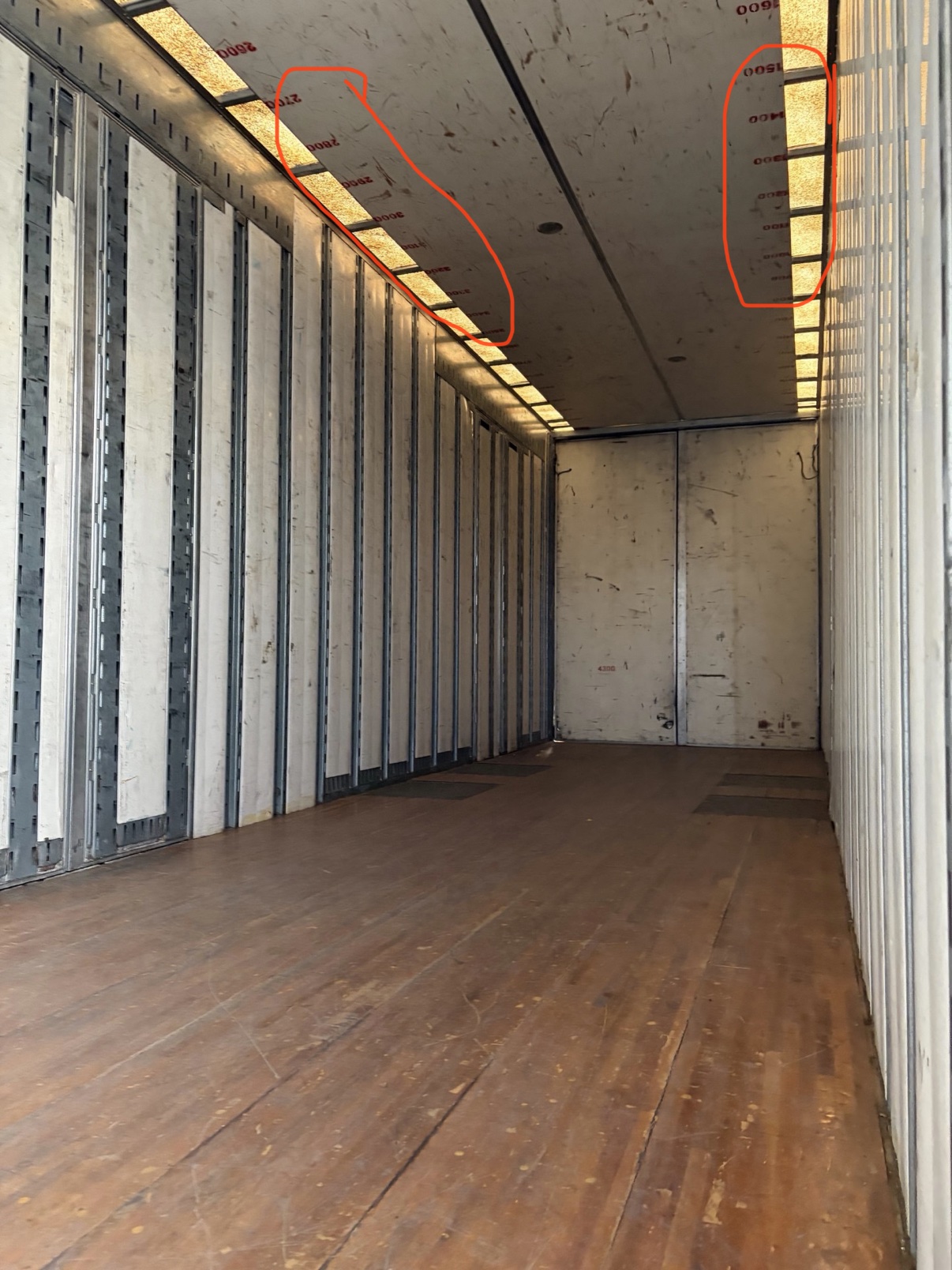
Most dedicated moving trucks are marked with their volume on the ceiling, on both sides, showing the cubic feet at each point along the box. As the truck loads, those markings show how much space your load has actually reached.
If a mover claims more volume than the markings inside their own truck show, ask why, in writing, before you pay it.
53-foot semi trailers
The biggest trucks used for household goods — but not unlimited, and the type of trailer matters.
| Semi type | Trailer | Typical volume |
|---|---|---|
| Household-goods semi | 53′ household-goods trailer | 4,200 cu ft |
| Low-to-the-ground semi | 53′ household-goods trailer, lower floor | 4,500–4,700 cu ft |
| Freight semi | 53′ standard freight dry van | 4,000 cu ft |
Low-to-the-ground trailers sit lower, so the usable space inside is taller — worth roughly 300–500 extra cubic feet. A standard freight dry van is a different trailer and holds less: use 4,000 cu ft, not the household-goods figures.
The quick sanity check
Typical shipment volumes by home size, against the trucks above.
| Home size | Typical volume | Comparable truck |
|---|---|---|
| Studio | ~400 cu ft | 10′–12′ truck |
| 1-bedroom | ~750–800 cu ft | 15′–16′ truck |
| 2-bedroom | ~1,000–1,200 cu ft | 20′–22′ truck |
| 3–4 bedroom | ~1,700 cu ft | A full 26′ truck |
| 4–6 bedroom | ~2,000+ cu ft | Largest rental trucks / dedicated |
Packing boxes by size and cubic feet
Trucks are only half the math. Most of an inventory is boxes, and boxes come in settled sizes with settled volumes. A mover who lists a medium box at 5 cubic feet, or a small box at 3, is inflating the load on paper before anything is loaded.
Standard boxes
U-Haul's standard range; Home Depot, Lowe's and others are close at medium, large, and extra-large. Heavy items go in small boxes; light, bulky items in large ones.
| Box | Dimensions | Cu ft | What goes in it |
|---|---|---|---|
| Book box | 12″ × 12″ × 12″ | 1.0 | Books, records, tools, canned goods |
| Small | 16⅜″ × 12⅝″ × 12⅝″ | 1.5 | Books, files, small appliances, heavy items |
| Medium | 18⅛″ × 18″ × 16″ | 3.0 | Kitchenware, toys, decor, small appliances |
| Large | 18″ × 18″ × 24″ | 4.5 | Bedding, towels, pillows, folded clothes |
| Extra-large | 24″ × 18″ × 24″ | 6.0 | Comforters, pillows, lampshades — light items only |
Specialty boxes
Where inflated inventories hide. Dish pack, China box, and dish barrel are the same box under three names — never let an inventory count it twice.
| Box | Dimensions | Cu ft | What goes in it |
|---|---|---|---|
| Dish pack / China / Dish barrel | 18″ × 18″ × 28″ | 5.25 | China, dishes, glassware — double-walled |
| Wardrobe — Shorty / Small | 24″ × 24″ × 34″ | 11.3 | Shirts, blouses — about 2 ft of closet rail |
| Wardrobe — Medium | 18″ × 18″ × 46″ | 8.6 | Hanging clothes — about 1½ ft of rail |
| Wardrobe — Grand / Tall | 24″ × 21″ × 48″ | 14.0 | Long dresses, suits, coats — about 2 ft of rail |
| Mirror / Picture — standard | 37″ × 4″ × 27″ | 2.3 | Frames and mirrors up to 37″ × 27″ |
| Mirror / Picture — large | 48¼″ × 4⁵⁄₁₆″ × 32¹¹⁄₁₆″ | 3.7 | Larger frames up to 48″ × 32″ |
What an interstate move should cost
Use price itself as a check. Interstate moves are priced by weight and mileage, not by the hour — if an interstate quote is explained as an hourly rate, ask for the estimate again, in writing.
Average interstate prices — base transportation
Published 2026 full-service ranges, base transportation only. Packing, storage, and extras are separate. Published sources disagree — judge a quote against a range, not a single number.
| Route | Typical distance | Studio / 1-bed | 2–3 bedrooms | 4+ bedrooms |
|---|---|---|---|---|
| Short interstate | Under 500 miles | $1,500–$3,000 | $2,500–$5,500 | $4,500–$8,000 |
| Mid-range / north-to-south | 1,000–1,500 miles | $2,500–$4,500 | $4,500–$8,500 | $6,500–$12,000 |
| Coast-to-coast | 2,500+ miles | $3,500–$6,500 | $6,500–$11,000 | $9,500–$15,000+ |
The $7–$10 per cubic foot cross-check
From over 14 years in this business: prices average about $7 to $10 per cubic foot, without fuel surcharge. Enter the cubic feet on your quote:
Ask the mover to show the quote before fuel surcharge is added, and compare. If their before-fuel price doesn't sit near this range, ask why — in writing.
Packing is always extra
Packing is on top of the $7–$10 transport rate, never included in it — averaging $1.50–$1.75 per cubic foot of the total shipment:
- 1,000 cu ft → about $1,500–$1,750 extra for packing
- 1,700 cu ft → about $2,550–$2,975 extra for packing
Combined with packing, the full rate is $8.50–$11.75 per cu ft, before fuel surcharge. Packing should appear as its own line — not hidden inside the transport rate.
Why below-average broker quotes turn into padded volume
That $7–$10 range is pretty much the national average for all moving companies. A quote below it is a major red flag — and an even bigger one when it comes from a broker rather than the company that will actually do the move. Here's the mechanism:
The broker sells low
The broker sells the job on a low total estimate. The low price is what gets you to sign.
The broker keeps half
The broker keeps 50% to 55% of that total estimate as commission — leaving the moving company that actually does the move with almost nothing to do it on.
The mover pads the volume
To get back to a profitable rate, the mover inflates the shipment's volume at your house — padding the claimed cubic feet back toward the same $7–$10 rates. The sudden "growth" on moving day is built into the economics of the low quote.
What destination service alone costs — wholesale interlining rates
What a moving company pays an interlining (destination) agent per cubic foot, just for the delivery-end service:
| Route | Wholesale rate / cu ft |
|---|---|
| Coast to coast | $3.50 – $3.75 |
| North to south (depends which coast) | $2.25 – $2.50 |
| Midwest to Texas | ≈ $2.25 |
| Midwest to the Southeast | $2.25 – $2.50 |
| Midwest to the Southwest | $2.75 – $3.00 |
| North of I-80 — add for weather, hard accessibility & tolls | + $0.25 – $0.50 |
Northern routes always cost more: weather delays, inclement weather, very hard accessibility, and tolls are built into the price, and destination agents charge a little more on that side for the same reasons.
The delivery date they promise isn't always the date you get
A moving company or broker can promise you a fast delivery timeframe that was never realistic for the price you paid. The delivery window is not just a date on a calendar — it depends on how full the truck is, who else is sharing it, what kind of truck is doing the driving, and whether you actually paid for expedited service. If those things don't add up, the promise won't hold.
Say your load is going from Seattle to Florida and it does not fill the whole truck. You paid a normal fee — not an expedited one. That means you are sharing the truck with other shippers. Sharing is exactly why the price is lower: the cost of the trip is split across several loads, not carried by you alone.
A shared load also sets the clock. The truck may need to pick up or drop off other shipments along the way, and your delivery fits into that route — not a straight, dedicated run to your door. So even before you count driving time, a shared-truck price and a dedicated-truck timeframe do not go together.
Even leaving the same day, the driving alone takes about five days
Drivers are limited to 11 hours of driving per day. That limit is the law, not a company policy a dispatcher can waive because someone promised you a date. For a single driver, Seattle to Florida at 11 legal driving hours a day works out to about five days of driving — and that is if the truck leaves the same day you load. Loading, stops, other shippers' pickups and deliveries, and rest all come on top of that.
Five days is the floor for the driving itself with one driver — not a worst case, and not a guarantee. Anyone promising you this route in two or three days at a normal shared-truck price is promising something the driving hours don't allow.
Sleeper cab — the driver can sleep in the truck
The five-day figure assumes a sleeper cab: a long-haul truck with a sleeping berth behind the seats, built for cross-country driving. The driver can take their required rest in the truck itself, so the trip runs on driving hours and rest periods — no nightly hunt for a hotel.
- Sleeps in the truck — rest happens in the berth, wherever the day's driving ends.
- Made for distance — this is the equipment a Seattle-to-Florida run is planned around.
Box truck — no place to sleep, and a hard drive
A box truck is a very different proposition over that distance. It is very uncomfortable to drive that far, and drivers normally cannot sleep in the truck — there is no berth. They still have to stop every night, which means finding and paying for hotels along the way.
- No sleeper berth — nightly hotel stops are part of the trip, not an extra.
- Harder, slower going — if a company says a box truck will cover a cross-country distance on a sleeper-cab schedule, ask how.
What "expedited" actually costs — and why
If you have a small shipment and you want it there faster, that faster timeframe is expedited delivery — and there is a surcharge for the expedited timeframe. You are no longer just paying for your space in a shared truck; you are paying to change how the truck runs.
What many companies do is charge for the whole truck in order to expedite the delivery timeframe — even though your goods only fill part of it. That is what makes the faster date possible: the truck runs for you, instead of waiting to fill up and stopping for other shippers.
Some companies go further and charge double the rate for a dedicated back-and-forth run with a box truck — the truck goes out with your load and comes back, and you are paying for that dedicated round trip. A double rate for a dedicated run is not, by itself, a scam. What matters is that it is quoted openly as a dedicated, expedited price — not disguised as a normal shared-truck price with a fast promise attached.
Ask these two questions before you sign
"Is this price for a shared load or a dedicated truck?"
"What is my delivery window — and will you put it in writing?"
Get the delivery window in writing — in the estimate or contract, not as a verbal assurance from the person who sold you the move. If the answer is "shared," expect a shared schedule. If you need a faster date, expect — and get quoted — the expedited surcharge.
Every mover must have a published tariff — and you have the right to see it
Behind every legitimate mover's prices there is a document most customers never hear about: the tariff. By law, every moving company must have one — and every customer can request it and read it. It is one of the strongest checks you have, because it turns "trust me, that's our fee" into something you can verify on paper.
What a tariff is
A tariff is the mover's own published list of its rules, regulations, the services it offers, and the charges that result from those services — in plain terms, the company's official book of how it runs a move and what each part of that move costs. It is the document the mover's prices are supposed to come from.
That cuts both ways, in your favor: the charges a mover assesses must be contained in its published tariff. A fee that isn't in the tariff isn't a fee the mover gets to invent at your door, on a loading dock, or over the phone at delivery. And the tariff is not internal paperwork kept in a back office — it must be made available to you upon request. Asking to see it is exercising a right, not asking for a favor.
Ask for the tariff before you sign
Ask while you are still comparing companies — not on moving day. Say it plainly:
"Please send me your published tariff."
A legitimate mover can produce it. Hesitation, excuses, or "we don't really have one" are answers in themselves.
Compare your estimate against it
Go through your estimate line by line — transport, packing, fuel surcharge, stairs, long carry, shuttle, storage — and find each charge in the tariff, at the amount or rate the tariff states. A charge that appears in your estimate but not in the tariff, or at a higher figure than the tariff allows, needs an explanation in writing before you sign.
Compare your Bill of Lading against it, too
On moving day, the Bill of Lading is your contract for the move itself — check its charges against the tariff the same way. New fees that surface at loading or delivery are exactly where off-tariff charges appear. If a charge isn't in the tariff, challenge it on the spot, in writing, before you pay it.
Every interstate mover must offer arbitration — ask about the program before you book
Most people only think about disputes after something is already lost, damaged, or overcharged — when the mover holds all the leverage. There is a protection built for exactly that moment, and it exists before you ever sign: every interstate mover is required to participate in a dispute resolution — arbitration — program for loss and damage claims, and to offer arbitration to its customers.
What arbitration means for you, in plain language
Say something goes wrong: furniture arrives damaged, items are missing, or you are charged more than you agreed. You file a claim with the mover — and the mover denies it, lowballs it, or stops answering. Without arbitration, your remaining option looks like hiring a lawyer and going to court over a couch.
Arbitration is the middle path the law builds in. If a claim about loss, damage, or charges cannot be settled directly with the mover, you can take it to the mover's arbitration program instead: a neutral third party reviews your claim and the mover's side and decides the dispute — no courtroom required. The mover doesn't get to be the final judge of its own claim decision.
Ask before you book — while you still have choices
Don't wait for a damaged dresser to learn how disputes work. While you are still comparing movers, ask:
"What is your arbitration program, and how do I start a claim if something goes wrong?"
A real mover answers with a program name and a process. Write down what they tell you and keep it with your moving paperwork.
Try to settle it directly first
Arbitration is the backstop, not the first move. If something is lost or damaged — or a charge looks wrong — file your claim with the mover, in writing, with your estimate, inventory, Bill of Lading, and photos. Many claims end here, with a settlement. What matters is that a dead end with the mover is not the end of the road.
If direct settlement fails, invoke the program
If the mover denies your claim, offers far less than the loss, or won't respond, you can take the dispute to its arbitration program rather than facing court as your only option. A neutral arbitrator hears both sides and makes the call. This is exactly the situation the requirement exists for — a customer with a legitimate claim and a mover who won't make it right.
Every customer must receive the booklet: Your Rights and Responsibilities When You Move
There is one document written for you — not for the mover — and federal law says you are supposed to have it in your hands before any contract exists: the FMCSA booklet Your Rights and Responsibilities When You Move. If nobody handed it to you, that is not a small paperwork miss. It is the first check on this page you can run in under a minute.
The rule: before a contract is executed
For an interstate move, the mover is required to provide this booklet to every prospective shipper before a contract is executed — that is, before you sign and become bound. It can be given to you either way the law allows: a copy of the booklet itself, or a hyperlink to the publication. A printed copy in the estimate packet or a working link in an email both satisfy it — silence satisfies nothing.
The timing is the point. The booklet exists so you understand the rules of the move before you are committed — not after your goods are loaded, and not when a dispute starts. A mover that only mentions it after you have signed has handed it to you at the one moment it can no longer protect you.
What the booklet covers
Types of estimates
What binding, binding not-to-exceed, and non-binding estimates actually mean — and how much more than the estimate you can be required to pay at delivery under each type. This is the difference between a price and a guess.
Valuation coverage
The mover's liability for loss and damage, explained: Released Value coverage versus Full Value Protection, what each one pays if something is broken or lost, and why the choice you make before the move decides what you can recover after it. The full breakdown — including the $0.60-per-pound math and how local moves differ — is in the valuation section below.
The claims process
How to file a claim for lost or damaged goods, the deadlines that apply, and what the mover must do with your claim once it is filed — so a dispute follows a process instead of depending on whether the mover feels like answering.
Didn't receive it? Ask for it
If you reached the point of signing without the booklet or its link ever being offered, stop and ask — plainly:
"Please send me the booklet 'Your Rights and Responsibilities When You Move' — or the link to it."
Asking costs you nothing and tells you a great deal: a legitimate mover sends it right away.
Read it before you sign anything
Do not sign the estimate or contract first and read later. The booklet is short, and the sections on estimate types and valuation coverage are exactly the ones that decide what you pay and what you can recover. Fifteen minutes with it, before signing, is the cheapest protection in this entire guide.
Get it yourself from FMCSA
You don't have to wait on the mover. The booklet is published by the Federal Motor Carrier Safety Administration and is available free on FMCSA's Protect Your Move site — the same federal resource this guide points to for verifying movers:
FMCSA Protect Your Move — https://www.fmcsa.dot.gov/protect-your-moveYour right to move by weight — and to be at the scale for every weighing
If your interstate move is priced by weight, the weight is not whatever the mover writes on the bill. It comes from a scale, in two weighings you have the right to watch happen. This is the weight version of the cubic-feet math earlier in this guide: a number you can verify yourself, instead of a number you are asked to trust.
How a weight-priced move is weighed: twice, on a certified scale
The truck is weighed twice on a certified scale — once empty and once loaded. The difference between the two is the only weight you can be charged for:
Gross weight
The truck loaded with your shipment, weighed on the certified scale.
Tare weight
The same truck empty — before loading or after unloading — weighed on the certified scale.
Net weight
Gross minus tare. This difference is the weight of your shipment — and the billing weight your charges are based on.
If a weight is not the difference between a gross and a tare weighing on a certified scale, ask where it came from. A guessed, rounded, or "standard" weight is not a weighing.
Your right to observe every weighing
You have the right to observe all weighings of your shipment — the empty (tare) weighing and the loaded (gross) weighing alike. And this right does not depend on you knowing to ask: the mover must inform you of your right to observe.
Informing you means more than mentioning it in passing. For each weighing, the mover must tell you where and when it will occur, and give you a reasonable opportunity to be present. A weighing done at an undisclosed scale, at an undisclosed time, that you only hear about afterward was not a weighing you had a real chance to observe.
"Where and when will the tare and gross weighings take place? I want to be there for both."
Ask before loading starts, and note the scale's name and location with your paperwork.
For a weighing to count, the conditions have to match
The tare and gross numbers are only comparable if the truck is in the same condition both times — apart from your goods. Watch for all of these at each weighing:
- All equipment on board — all pads, dollies, hand trucks, and ramps are on the vehicle for both weighings.
- Everybody off the vehicle — the driver and any other persons are off the truck while it is on the scale.
- Fuel handled the same way — fuel tanks are full at each weighing, or no fuel is added between the weighings.
Equipment left off for the empty weighing, a driver sitting in the cab, or a fuel stop between weighings all push the "net" weight up or down without your goods changing at all.
If you dispute the weight: your right to a reweigh
Maybe you watched the weighings and something looked off. Maybe you didn't, and the billing weight is far above what your shipment should weigh. Either way, a disputed weight is not settled just because the mover says so — you have the right to have the shipment weighed again.
Know the window: after you're told, before unloading
Your reweigh right arises after the mover informs you of the billing weight and the total charges — that is the moment you can judge whether the weight makes sense. For a shipment that was weighed at origin, you must demand the reweigh before unloading begins at destination. Once the truck is unloaded, a reweigh of that shipment is no longer possible — so if you are going to dispute the weight, dispute it at that point, before the doors come down and unloading starts.
Demand the reweigh — and observe it the same way
Say it plainly, and preferably in writing:
"I dispute the weight. I am requesting a reweigh before unloading begins."
You have the same right to observe the reweighings as the original weighings — the reweigh is itself a tare and a gross weighing, empty and loaded. The mover must tell you where and when the reweigh will occur and give you a reasonable opportunity to be present for it, just as with the first weighings. The same conditions apply too: equipment on board, everybody off the vehicle, and fuel full at each weighing or not added in between.
The reweigh weight is the billing weight
A reweigh is not a second opinion the mover can take or leave. The mover must base the freight bill charges on the reweigh weight — if the reweigh comes in lower, your charges are recalculated on that lower weight. Do not pay a freight bill that still rests on the original, disputed weight after a reweigh has been done.
Get the signed weight tickets — true copies with the freight bill
For each weighing — original tare and gross, and reweigh tare and gross if there is a reweigh — the mover must obtain a signed weight ticket. And the mover must present true copies of all weight tickets with the freight bill. "True copies" means copies of the actual scale tickets, not a weight typed onto the bill. Check every ticket: the gross minus the tare should equal the net weight you are billed for, and the tickets should match the scale, dates, and weighings you were told about. No tickets means no proof of weight — challenge a weight-based bill that arrives without them.
Valuation: the two options that decide what you get back if something is lost or damaged
Price gets all the attention before a move. Valuation — the mover's liability for your goods — gets one rushed line on the paperwork. Yet that one line decides what you can recover if a truckload of your life arrives broken, or doesn't arrive at all. For an interstate (long-distance) move there are exactly two options, and they are not close to equal.
Full Value Protection
The mover is liable for the current replacement value of your goods if they are lost or damaged. This is the higher level of protection — and you pay for it:
- You pay a premium (a valuation charge) for this level of protection, added to the cost of the move. It is not included free.
- Deductible options affect the cost. Choosing a deductible lowers the charge; a lower or zero deductible raises it. Get the deductible you picked — and the premium you were charged — in writing.
- If something is lost or damaged, the mover may repair the item, replace it with a similar item, or pay its current market replacement value. The choice among those three is the mover's — but the value is based on what the item is actually worth now, not what it weighs.
Released Value
The basic option, included at no additional charge — and the lowest level of protection there is:
- The mover's liability is capped at $0.60 per pound per article for an interstate move — sixty cents for every pound an item weighs, no matter what the item is.
- Payout is based on weight, not value. Light, expensive things — electronics, artwork, a laptop — recover almost nothing.
- Many customers end up with Released Value without realizing they chose it. It is what you get when the valuation line gets no real attention before signing — and people usually find out what it means only after something is already damaged.
Do the Released Value math before you accept it
Released Value pays by the pound. Run your own furniture through the formula and the "coverage" stops sounding like coverage:
A 100-pound item is covered for $60 — no matter what it actually cost. That is the whole option. If that number would hurt, Released Value is the wrong choice, whatever it saves you up front.
The choice must be in writing — before the move
Valuation is not a verbal understanding and it is not decided when something breaks. It is a selection you make, in writing, before the move happens.
Choose before the move, in writing
You must make your valuation choice in writing before the move — Full Value Protection or Released Value. A conversation, a handshake, or a salesperson's assurance is not a choice. If it isn't written down and signed, it doesn't exist when a claim is filed.
It goes on the Bill of Lading / order for service
Your choice is recorded on the Bill of Lading / order for service. Find the valuation line before you sign: your selection should be marked, and if you chose Full Value Protection, the premium and the deductible should appear with it. Never sign with the valuation line blank or unchecked — see the warning on blank Bills of Lading below — and photograph your signed copy.
It cannot be switched later
Once the choice is made and the move is underway, the mover cannot switch it later — not on moving day, and not after something is lost or damaged. The option on your paperwork is the option your claim is settled under. That is why the two minutes spent on this line before signing matter more than any argument you can have afterward.
Local (intrastate) moves: the $0.60 figure does not travel
Everything above is the interstate rule. A move within one state — an intrastate move — is governed by that state's rules, and Released Value is not the same $0.60 everywhere.
Released Value varies by state
States set their own released-value rate for local moves. Some states are at $0.30 per pound per article; some are as low as $0.15 per pound per article — a quarter of the interstate figure. The same 100-pound item that recovers $60 on an interstate move recovers:
Before a local move, check your own state's rule — ask the mover, in writing, what released-value rate applies in your state, and what higher-protection options it offers for an intrastate move. Your state's consumer protection office (see the Resources page) can confirm the rate.
Ask about the mover's cargo coverage and truck coverage — do not be shy
Most customers ask about price, dates, and valuation — and never ask what insurance the mover itself carries. That is a mistake. The mover's own cargo coverage and the liability coverage on its truck are part of whether the company is real, serious, and able to stand behind a bad day. Asking about them is not rude and it is not unusual. A legitimate mover expects the question and answers it with numbers.
Cargo coverage: the federal minimum is only $5,000
By DOT / FMCSA regulations, the minimum cargo coverage for moving companies is only $5,000. Not many people know that — and $5,000 is very low against a truckload of household goods. A single high-end sofa, a piano, or a room of electronics can be worth more than the entire minimum policy.
- $5,000 is the floor, not a serious level of protection. It is the least a mover can carry and still meet the federal minimum — not a number chosen because it would actually cover your belongings.
- Real, legitimate moving companies carry far more. A mover that knows it is moving high-end items will carry at least $100,000 in cargo insurance — because it knows what is actually on its trucks.
- A mover hiding behind the $5,000 minimum while offering to move expensive household goods is telling you its protection has not kept up with the value it wants you to hand over.
Truck liability: the minimum is $750,000
Cargo coverage is about your goods. The truck itself carries a separate liability policy — the coverage that responds if the truck is in an accident and someone is hurt or property is damaged. By DOT / FMCSA regulations, the minimum liability coverage for movers is $750,000 for the truck.
- $750,000 is also a floor. It is the minimum required — ask what the mover actually carries, not just whether it meets the minimum.
- Ask about the truck, not just the goods. A mover can talk confidently about your furniture and still be vague about the truck hauling it. Both numbers matter, and both should be easy for a legitimate company to state.
- No number is an answer too — and not a good one. See the red flag below.
Ask both questions — word for word — and ask for proof
Do not hint at it and do not accept "we're fully insured" as an answer. That phrase, with no amounts, tells you nothing. Ask the two questions directly, before you book:
- Ask about the goods: "How much cargo coverage do you carry?" — then follow up: is that per shipment, per truckload, or per vehicle? Get the amount in writing.
- Ask about the truck: "How much liability coverage is on the truck?" — the truck that will actually haul your move, not a fleet average or a number from a brochure.
Then ask for proof — a certificate of insurance or policy documentation naming the coverage amounts — and check the mover's insurance on its FMCSA SAFER record yourself. The SAFER Company Snapshot shows the mover's insurance filings; how to pull it up, step by step, is in Protect yourself before you book, and the direct link is on the Resources page. If the amount the mover states, the proof it shows you, and the SAFER record do not line up, stop and get an explanation in writing before anything is loaded.
Do not confuse cargo coverage with valuation — they are separate protections
These two get mixed up constantly, and the mix-up costs customers money. They sound alike; they are not the same thing, and one does not replace the other.
Cargo coverage — the mover's insurance
Cargo coverage is the mover's own insurance policy on the freight it hauls — the subject of this section. It tells you what level of insurance stands behind the company carrying your goods: $5,000 at the federal minimum, $100,000 or more at a serious, legitimate mover. You do not choose it and you do not buy it — the mover carries it. Your job is to ask how much it is, and to verify it.
Valuation — what the mover owes you
Valuation is the mover's liability to you for loss or damage to your goods — the choice covered in the valuation section above: Full Value Protection, which you pay a premium for, or Released Value at $0.60 per pound per article. That choice — made by you, in writing, before the move — is what decides what you can recover on a claim.
Accessorial services: the extras beyond loading, transport, and unloading
Almost every move involves more than the truck ride itself. The extra work around that ride has a name — accessorial services — and a price. None of these charges is automatically a scam. The scam is when one appears for the first time on moving day, after your goods are loaded, at a price nobody ever showed you.
What "accessorial" means
Accessorial services are extra services beyond the basic move — beyond loading your goods, transporting them, and unloading them at the other end. They cover the additional work, equipment, time, and handling a particular move actually needs: a long walk from the truck, stairs to climb, a piano to move, boxes to pack, a night in storage.
Each one is charged in addition to the transportation charge — on top of the price for the transport itself, not inside it. That is why a quote can look complete and still grow: the transportation charge was only ever part of the bill. Knowing which accessorial services apply to your move, and what each one costs, is how you see the whole bill before you sign.
The common accessorial services — in plain language
These are the extras that show up most often. Read the list against your own home and belongings: if one of them describes your move, it should already be in your estimate.
Long carry
A charge for carrying your goods farther than the distance included in the basic price — when the truck has to park well away from your door: a long driveway, a parking lot across the complex, a house set back from the street. The farther the walk, the more trips the crew makes on foot.
Stairs / flights of stairs
A charge for carrying goods up or down flights of stairs at pickup, at delivery, or both — typically counted per flight. A third-floor walk-up and a ground-floor ranch are not the same job, and movers price the difference here.
Elevator use
A charge that can apply when the crew must use an elevator instead of loading at ground level — common in apartment and condo buildings. Elevator trips are slower than a straight walk to the truck, and some buildings require the elevator to be reserved or padded.
Shuttle service
When the big truck cannot reach your home — a narrow street, low branches or wires, a steep or tight driveway, a gated community — a smaller shuttle truck ferries your goods between your door and the big truck parked where it can fit. It is a second truck, a second crew run, and a separate charge.
Bulky or oversized items
Extra handling for items that are unusually heavy, large, or awkward: pianos, safes, pool tables, and large appliances. These need more crew, special equipment, or both — and a safe or piano is never just "one more item" to carry.
Packing and unpacking
The mover's crew packs your boxes for you — wrapping, boxing, and labeling your belongings before the move — and, if you choose it, unpacks them at the other end. Packing is always extra: in this guide's pricing it runs about $1.50–$1.75 per cubic foot on top of transport.
Crating
Building a custom wooden crate around a fragile or high-value item — artwork, a mirror, a glass or marble tabletop, an antique — so it travels protected in a way a blanket and a box cannot achieve. The crate is built for that one item, and it is charged per item crated.
Disassembly and reassembly
Taking furniture and other items apart so they can be moved safely — beds, large tables, shelving, exercise equipment — and putting them back together at delivery. Work at both ends of the move, charged as an extra service.
Storage-in-transit
Your shipment is held in the mover's storage for a period between pickup and delivery — because your new home isn't ready, closing slipped, or dates don't line up. Storage is charged for the time your goods sit, and delivery out of storage can carry its own handling charge.
Waiting time / extra stops
Time and stops beyond the plan: the crew waiting because a building, elevator, closing, or key handover isn't ready when the truck arrives — or an extra stop to pick up or drop off goods at a second address or a storage unit along the way. Both consume crew hours the basic price didn't include.
Fuel surcharge
Where it applies, an additional charge tied to the cost of fuel, added on top of the transportation charge. It should appear as its own line, at a stated rate — which is why this guide's $7–$10 per cubic foot cross-check is done before fuel surcharge, so you can compare like with like. How the surcharge is actually calculated — from the government's diesel price index — is covered in the next section.
Which of these are yours?
Walk your own move through the list: stairs? A long walk to the truck? A piano, a safe, a building elevator, a street a semi can't enter? Every one you can already see, the mover can see too — and it belongs in your estimate, priced, before booking.
Talk about access and shuttle at booking — not on moving day
Every accessorial service — and every circumstance that could trigger one — has to be talked about during booking, while you can still walk away. That conversation is not small talk. It is how you find out, in advance, whether a semi can reach your homes, whether a shuttle might be needed, what it would cost, and who arranges it. If it was never discussed, it can still be charged — only now it arrives as a surprise, after your goods are loaded.
Most moves are serviced with a semi truck
Most moves around the country are serviced with a semi truck — especially large moves. That is the truck your price is built around, and it is the truck you should picture when you think about access at both ends of the move.
Sometimes a small box truck works instead — for short distances, or when the customer is paying a premium for that smaller truck. But do not assume a box truck is coming, and do not let a salesman leave it vague. If the plan depends on a box truck, get that in writing. Otherwise, plan for a semi — because that is where access is decided.
Most trouble arises when a semi cannot get in
Most shuttle trouble arises the same way: you are moving with a semi and you do not have access for it. The places that stop a semi are ordinary places people live:
- Country roads — narrow, soft-shouldered, low-branched, or not built for a long trailer's turn.
- Tiny downtown streets — parked cars, one-way turns, and corners a semi simply cannot make.
- Very tight roads and narrow roads — where the truck fits on paper but cannot pass, turn around, or park without blocking everything.
- Roads restricted by municipalities for big semis — weight, length, or truck-route rules that bar the truck from the street entirely, no matter how careful the driver is.
- HOAs — see below. For semis, they are a problem all on their own.
When a semi cannot reach the door, the answer is usually a shuttle: a smaller truck ferries your goods between your home and the semi parked where it can legally and safely sit. That means extra handling, extra time, and a separate charge — which is exactly why it has to be priced and planned at booking, not discovered at the curb.
When the delivery address cannot be checked yet
Sometimes accessibility honestly cannot be checked in advance — and a good salesman will say so plainly instead of guessing. The most common case: your goods are going to storage and will not be delivered right away, and you do not have a delivery address yet. There is no address to look up, drive by, or measure, so nobody can confirm today whether a semi will reach the home you eventually deliver to.
That unknown does not end the conversation — it changes it. At booking, talk through the possibility itself: that a shuttle may be needed at delivery, what the shuttle would cost under the tariff, and who arranges it if it is. Get that possibility and its price in writing now, and revisit access the moment you have a delivery address — before the truck is dispatched, not when it is already on your street.
HOAs are a big problem for semis
Homeowners associations are a big problem for semis. HOA rules can bar large trucks from entering, limit the hours or days a truck may be there, forbid overnight or street parking, require advance approval or a gate pass, or restrict which entrance a truck must use — any one of which can force a shuttle even on a street a semi could physically drive.
So talk about HOA rules and access with your HOA and with the mover before booking — at the pickup home and at the delivery home. Ask your HOA directly what its rules are for a semi and for moving trucks, then tell the mover exactly what the HOA said, and get the mover's plan — semi, or shuttle and at what cost — in writing.
"Can a semi reach both addresses, and if not, what will the shuttle cost and who arranges it?"
Ask it for the pickup address and the delivery address, and get the answer in writing. If the delivery address does not exist yet because your goods are going to storage, ask what happens — and what it costs — if a shuttle is needed when it does.
Your protection: named, priced, in writing — before the move
You do not have to guess which extras apply, and you do not have to accept a total that only becomes clear at delivery. A legitimate mover settles all of this up front, in two places you can hold in your hand.
Named in the written estimate — each one, with its price
A legitimate mover names each accessorial service that applies to your move, with its price, in the written estimate — "stairs: $X," "shuttle: $Y," "packing: $Z" — before you book. Not a lump "extras" line, not a verbal mention, and never "extras to be determined." If a service applies and it isn't listed with a price, the estimate is incomplete.
And in the tariff
The same services and charges must be in the mover's published tariff. Ask for the tariff and check: the accessorial services in your estimate should appear there, at the amounts or rates your estimate uses. An accessorial charge that exists in neither document has no basis — see how to request and use the tariff.
Ask the question — before booking, and get the answer in writing
Do not wait for the mover to volunteer the list. Ask, exactly:
"Which accessorial services apply to my move, and what is the price of each?"
Then get the answer in writing — in the estimate itself, item by item. A mover who has surveyed your home can answer this question on the spot. One who won't put the answer in writing is keeping the option to price it later, when you have no leverage left.
Charges that are not actually move-related
The section above covered accessorial services — real extra work, charged on top of transport. There is another family of charges that is not accessorial at all. Nothing is carried farther, lifted higher, packed, or stored because of them. They are administrative and penalty-type fees that simply get added to the bill — and because no work stands behind them, they are exactly where a mover can quietly pad a price you thought you had already agreed to.
Administrative / admin fee
A flat charge for paperwork and office handling — processing your booking, your documents, your file. It is not tied to any work done on your belongings: nothing is loaded, carried, or delivered because of it. Some movers charge it on every job, some never do. Either way, it is a cost of the mover doing business being passed to you as a separate line — so it belongs in the quote you compare, not in a surprise at the end.
Rescheduling fee
A charge for changing your pickup or delivery date after you have booked. Life changes — closings slip, leases shift — and a mover may charge to move your slot on its schedule. Note what it is and is not: it compensates the mover for a schedule change, not for any service performed on your move itself. Before you book, ask whether it exists, how much it is, and what triggers it — a change you request weeks ahead should not be priced like a same-day cancellation.
Redelivery fee
A charge that appears when the mover attempts delivery and cannot complete it — nobody is there to accept the shipment, the building or elevator isn't available, or access at the destination fails — and the truck has to come back and deliver again. It is the fee movers reach for first, and "God forbid" is the right reaction: a failed first attempt can stack this fee on top of storage and waiting charges. Ask in advance what counts as a failed delivery, what the redelivery fee is, and how much notice the mover will give you before the truck arrives — most failed deliveries are scheduling and communication failures, and a mover who confirms the delivery window with you ahead of time prevents them.
Not accessorial — but still bound by the same rule
These fees are not services, but they are still charges — and the rule that governs every other charge on your bill governs them too: each fee, and its amount or how it is calculated, must be disclosed in the mover's published tariff and in your written estimate before the move. If an admin fee, a rescheduling fee, or a redelivery fee is real, it is written down somewhere you can read before you sign — in the tariff's list of charges and in the estimate you agreed to.
So before booking, ask the plain question: "Besides the accessorial services, what other fees can be added to my bill — admin fees, rescheduling fees, redelivery fees — and what is each one?" Then check the answer against the tariff, the same way you check everything else in the tariff section.
The fuel surcharge: an add-on with a formula, not a number the mover invents
The fuel surcharge sits in this section because it, too, is an additional charge on top of the transportation charge — not part of the transport price itself, and not payment for any extra work on your goods. But it is different from the fees above in one important way: a legitimate fuel surcharge is not set arbitrarily by the mover. It is calculated from the price of diesel fuel, using the U.S. government's own published numbers.
How the fuel surcharge actually works
Trucks run on diesel, and diesel prices swing. Instead of rebuilding its transport rates every time fuel moves, the industry adds a fuel surcharge: a percentage added on top of the transportation charge, which rises and falls with the price of diesel.
The percentage is derived from the government's published diesel fuel price index — the weekly retail diesel price published by the U.S. Department of Energy, through its Energy Information Administration (EIA). That index is public: anyone can look up this week's national average diesel price. The mover's tariff contains a table or formula tying the index price to a surcharge percentage — when diesel is at one price, the surcharge is one percentage; when diesel climbs, the percentage steps up; when diesel falls, it steps back down.
That is what "derivative of the price of diesel" means in practice: the surcharge moves because the index moved — not because the mover felt like charging more. A surcharge that stays at its highest level while diesel prices have fallen, or a percentage nobody can trace back to the index and the tariff, is not a fuel surcharge. It is just a higher price wearing a fuel costume.
Ask these before you book
- How is the fuel surcharge calculated? Get the method — the table or formula — not just a percentage quoted over the phone.
- What index does it follow? The answer should name the government's index: the Department of Energy / Energy Information Administration weekly retail diesel price.
- What percentage applies at today's diesel price? The mover should be able to point at the current index price and show you the percentage it produces.
- Is it included in my quoted price, or added on top? This guide's $7–$10 per cubic foot cross-check is done before fuel surcharge — if a quote already includes it, you are not comparing like with like until you know.
- Does it match the tariff? The surcharge method and percentages must be the ones in the mover's published tariff. Check them there, like every other charge.
Six more traps — the ones that show up in the details
Beyond the low quote and the padded cubic feet, these six are where moves quietly go wrong. Each one is checkable before it costs you.
Who actually shows up
Your job can be sold or subcontracted more than once — broker to carrier, carrier to another crew — and each handoff is a chance for your price and promises to change. The company that matters is the one whose name and USDOT number are on the truck at your door. If that name doesn't match your contract, you are not obliged to let them load: photograph the truck, call the company you actually hired, and decide before anything goes on board.
How you pay decides what you can undo
Cash, Zelle, and wire transfers are gone the moment they're sent — there is no dispute process and no chargeback. A credit card payment can be disputed; a cash demand at delivery cannot. That's why scam movers push untraceable payment and why you should keep the deposit modest, pay by card where possible, and never pay the full balance before delivery.
Your reweigh rights
If your interstate move is priced by weight, you have the right to observe every weighing — empty (tare) and loaded (gross) — and, if you dispute the weight, to demand a reweigh before unloading begins and observe that too. The reweigh weight is the weight your bill must be based on, and you are owed signed weight tickets — true copies with the freight bill. A mover who resists a reweigh, or can't produce tickets, is telling you the weight on your bill deserves a second look. The full rules are in the weighing section above.
Surprise accessorial fees
Long carry, stairs, elevator, shuttle truck, storage-in-transit, packing materials, fuel surcharge — these "accessorial" charges are where a fair quote quietly grows. They are only predictable if they are named, with amounts or rates, in your written estimate. If your building has stairs, a long walk, or tight truck access, say so up front and get the fee in writing. "Extras to be determined" is an open door. The full list of services, and the question to ask before booking, is in the accessorial services section above.
Never sign a blank Bill of Lading
The Bill of Lading handed to you on moving day is your contract for the move itself — and a blank or partly blank one can be filled in later with a new price, new dates, or a different valuation than the one you chose. Read every field before signing, cross out empty fields or write "none," note any damage that already exists, and photograph your signed copy before the truck leaves. If the price on it differs from your estimate, stop and resolve it before loading.
Fake, cloned company identities
Scam operations copy real movers: a name one letter off a famous carrier, a legitimate company's USDOT number pasted onto a fake website, reviews that all appeared the same week. So don't verify a mover by the website it gives you. Look the USDOT number up in the federal record yourself (see the Resources page), then call the phone number on the federal record — not the one on the quote — and confirm the company at that number knows about your move.
On moving day — and if your goods are held
Before anything is loaded
- Confirm the company name and USDOT number on the truck and paperwork match your contract. Photograph the truck, its plates, and the crew's paperwork.
- Walk the inventory with the foreman before loading. Flag missing or inflated items then — not after the doors close.
- If the price changes before loading, stop. You can refuse the move at the new price and dispute the deposit later; you cannot easily undo a loaded truck.
- Never let loading start on a blank bill of lading or a revised estimate you haven't read and agreed to in writing.
During & after the move
- Keep your valuables, documents, medication, and chargers with you — never on the truck.
- Note damage and missing items on the delivery paperwork before signing it as complete.
- For an interstate move priced by weight, you have the right to observe all weighings — tare (empty) and gross (loaded) — and the mover must tell you where and when each will occur. If you dispute the weight, demand a reweigh before unloading begins; the bill must then be based on the reweigh weight, with true copies of all signed weight tickets presented with the freight bill. See the weighing section.
- If a dedicated truck arrived, check the ceiling markings against the volume you're charged for.
If your goods are held for more money
- Stay calm and document everything: names, USDOT numbers, plates, texts, every amount demanded, with dates and times.
- Don't pay an undocumented cash demand without a written revised estimate and receipt. A traceable payment is easier to dispute.
- File a household-goods complaint with the FMCSA National Consumer Complaint Database, and contact your state attorney general or consumer protection office.
- If goods are withheld in a way that feels like extortion or theft, contact local law enforcement where the truck is located.
- Keep every document. Complaints, chargebacks, and claims are won on paperwork, not memory.
Put a tracker in a couple of your boxes, just in case
Before loading day, put a small tracker — for example an Apple AirTag, a Tile, or a small GPS tracker — hidden inside a couple of your own boxes, so you can see where your goods actually are if delivery stalls, the company changes, or the load is held.
Inside the box — in at least two boxes
- Put the tracker hidden inside one of your own boxes while you are packing, before loading day — not taped to the outside, where it can be spotted and removed.
- Use at least two boxes, not just one. If one box is separated, opened, or its tracker goes quiet, the second gives you another chance of a location.
- Write down privately which boxes they are in, so you know what you are looking at when a location shows up — and keep that note with your own paperwork.
- Keep the tracker information private to yourself. Do not announce it to the crew or put it on the inventory or the Bill of Lading.
Know the limits
- An AirTag or Tile has no GPS or cellular signal of its own. It works through nearby phones on its finding network, so it can go quiet inside a metal truck or a warehouse until a phone comes within range.
- It may also alert a nearby phone that an unknown tracker is travelling with it — that is a safety feature of those networks, and it can mean the tracker is found.
- A true GPS tracker uses cellular signal and usually needs a subscription and charging. Its battery lasts days to weeks, not a year — charge it and check the plan before you pack it.
Evidence — not a confrontation
- A tracker location is evidence to help you — for a police report or an FMCSA complaint — if your goods are delayed or held.
- It is not a reason to confront a driver or crew alone. Give the location to law enforcement or the FMCSA instead.
- On its own, it does not prove who is holding the load — it shows where that box appears to be, not who has it or why.
Who is actually coming into your house? Ask for the crew's CID numbers
Vetting the moving company is not the same as vetting the labor it brings into your house. Before moving day, ask the company for the CID numbers of the specific employees actually scheduled to come to your house — and ask it to show you the active CID verification for each one.
The company is not the crew
- You cannot know whether the crew was vetted unless you ask. Taking the company's word for it tells you nothing about who actually shows up at your door.
- From the company's word alone, you cannot know if it is hiring day laborers, or where it is bringing the people in from.
- The people who come through your door are the ones with access to your home, your belongings, and your family — they deserve the same checking you gave the company itself.
What a CID number means
- A CID number is a LaborNet Consortium CID, accepted across the major van lines. It means that worker was vetted and checked against the federal database for criminal history.
- The check is a 7-year lookback covering the National Crime Information Center (NCIC) database, a federal criminal search, state and county criminal searches where the person has lived, and the national sex registry.
- The worker must have no felony convictions for the CID to be active.
- An active CID can be verified free at labornetapp.com/validate — check each number yourself.
Ask for proof — for your crew, by name
- Ask before moving day, for the specific employees actually scheduled to come to your house — not the company in general.
- Ask the company to show you the active CID verification for each scheduled crew member — not just a general claim that "our crews are background-checked."
- If the scheduled crew changes, ask again: get the new names and their CID numbers, and verify those instead.
The checklist — use it three times
Before you book, again before you sign, and again on moving day before loading starts. Keep it with your moving paperwork.
Before you book
- I have the company's legal name and USDOT number, verified with the FMCSA
- I know whether I hired a broker or a carrier, and who will actually pick up my goods
- I have at least three estimates for the same inventory and dates
- The mover did an in-home or live video survey of my belongings
- If the company is within 50 miles of my house, I asked "Are you within 50 miles of my house, and can you send someone for an in-home visual estimate?" A company claiming to be local that couldn't or wouldn't send someone, or offered only a phone estimate, I treated as a red flag — see In-Home Visual Estimate
- Before moving day, I asked for the CID numbers of the specific crew members actually scheduled to come to my house, and saw the active CID verification for each one — a LaborNet Consortium CID means a 7-year criminal-history check (NCIC, federal, state and county searches, and the national sex registry) with no felony convictions, verifiable free at labornetapp.com/validate — not just a claim that "our crews are background-checked." A company that couldn't or wouldn't name the scheduled crew or produce CID numbers, a different crew showing up, or labor hired day-of with no vetting, I treated as a red flag — see Crew CID Numbers
Before you sign
- My estimate is binding or binding not-to-exceed, in writing
- My inventory is itemized, and I checked every large item on it
- If priced by cubic feet, I checked the per-item figures with the formula, truck tables, and box tables — including my own box count and the wardrobe count against my closet rail
- I checked my quote against the price ranges and the $7–$10 cross-check (plus $1.50–$1.75 packing if quoted). A broker quote far below $7, I treated as a red flag, not a bargain
- My delivery window is in writing, and I know whether my price is for a shared load or a dedicated truck. A fast delivery promised at a shared-truck price, I treated as a red flag
- I asked "Which accessorial services apply to my move, and what is the price of each?" and got the answer in writing: every extra that applies — long carry, stairs, elevator, shuttle, bulky items, packing, crating, disassembly, storage-in-transit, waiting time / extra stops, fuel surcharge — is named, with its price, in my estimate and in the tariff. A charge first appearing on moving day, after loading, for a condition visible at survey, I treated as a red flag — see Accessorial Services
- I asked what other fees can be added to my bill besides accessorial services — admin fees, rescheduling fees, redelivery fees — and each one is disclosed in the tariff and in my written estimate. A fee first appearing on moving day or at delivery, I treated as a red flag — see charges that are not move-related
- I asked how the fuel surcharge is calculated: which index it follows (the Department of Energy / EIA weekly retail diesel price), what percentage applies at today's diesel price, and whether it is included in my quote or added on top — and I checked the method against the tariff
- I asked for the mover's published tariff before signing, compared every charge in my estimate against it, and will do the same with the Bill of Lading. A refusal to show it, or a charge that isn't in it, I treated as a red flag
- I asked what the mover's arbitration program is and how to start a claim if something is lost, damaged, or overcharged. A mover that couldn't name one, I treated as a red flag
- I received the booklet Your Rights and Responsibilities When You Move — or the link to it — before signing, and read it first. A mover that wouldn't provide it, I treated as a red flag
- My valuation choice is made in writing, before the move, on the Bill of Lading / order for service — and I understand what it pays: Full Value Protection (premium and deductible shown on the paperwork) or Released Value at $0.60 per pound per article interstate. For a local move, I checked my own state's released-value rate — it may be $0.30 or $0.15, not $0.60. I know the choice cannot be switched later
- I asked "How much cargo coverage do you carry?" and "How much liability coverage is on the truck?" — and got both numbers, not just "we're insured." I know the federal minimums are only $5,000 cargo and $750,000 truck liability, that a serious mover moving high-end goods carries at least $100,000 in cargo coverage, and I saw proof and checked the mover's insurance on its FMCSA SAFER record. A mover that wouldn't state its coverage, or hid behind the $5,000 minimum, I treated as a red flag — see Cargo & Truck Coverage. I know cargo coverage is separate from valuation, and I checked both
- No blank fields remain on any document I signed
- My deposit is modest and paid by a traceable method, ideally a credit card
On moving day, before loading
- The name and USDOT number on the truck match my contract — and I photographed them
- I walked the inventory with the foreman and corrected it before loading
- If a dedicated moving truck arrived, I checked the ceiling cubic-foot markings against the volume I was charged for
- No new price has been introduced. If one has, I stopped and reassessed before loading
- If my move is priced by weight, the mover told me where and when the tare (empty) and gross (loaded) weighings on a certified scale will occur and gave me a chance to observe them — with pads, dollies, hand trucks and ramps on board, everyone off the truck, and fuel full or not added between weighings. I know observing is my right, not a duty, and waiving it (in writing for a reweigh) doesn't affect my other rights
- If I dispute the weight after being told the billing weight and total charges, I will demand a reweigh before unloading begins, observe the reweighings, and make sure the freight bill is based on the reweigh weight and comes with true copies of all signed weight tickets
- My documents, valuables, and essentials are travelling with me, not on the truck
- Before loading day, I put a tracker (AirTag, Tile, or GPS) hidden inside at least two of my own boxes — not taped to the outside — wrote down privately which boxes they are in, and kept that information to myself. I know an AirTag/Tile can go quiet in a metal truck or warehouse, a GPS tracker needs charging and usually a subscription, and a location is evidence for a police report or FMCSA complaint, not a reason to confront the crew alone — see Tracker in Your Boxes
Real jobs — the truck, the load, the road
No stock photos. These are real moves, photographed on the job by EZ Moving & Hauling (@ez_da_hauler on Instagram) — the semi at the house, the load inside the trailer, and the miles in between. The first six photos link to their original Instagram posts.
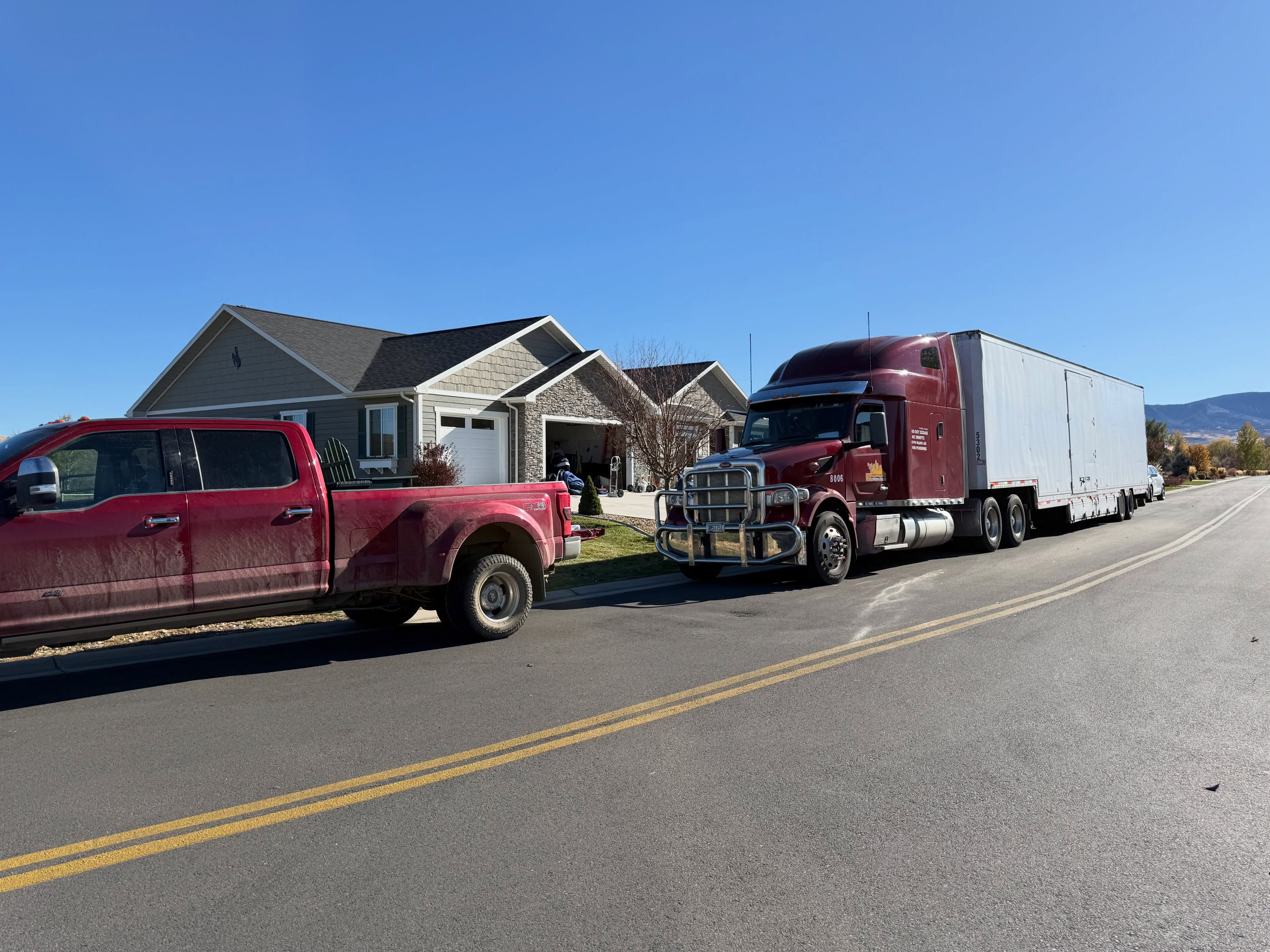
Out of a cold state, ahead of the snow
The semi at the house in Sheridan, garage open and equipment out — a move-out to South Carolina that made it out before a snowstorm.
View on Instagram →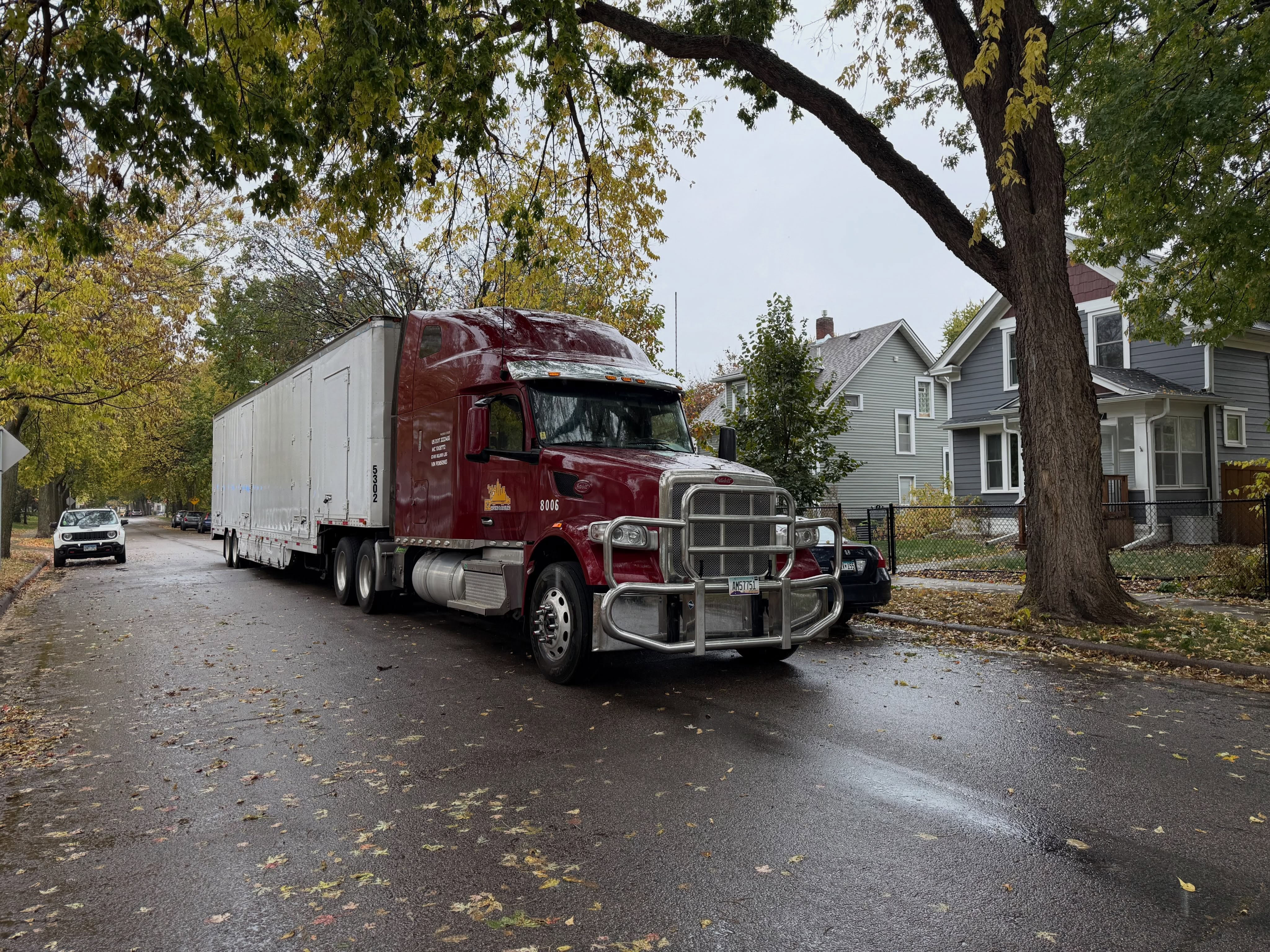
Rain day is hard — the move still gets done
Lifting big furniture in the rain, on downtown's narrow streets and in tight old homes — hard work, but customers still need to get into their new home, so the job gets done.
View on Instagram →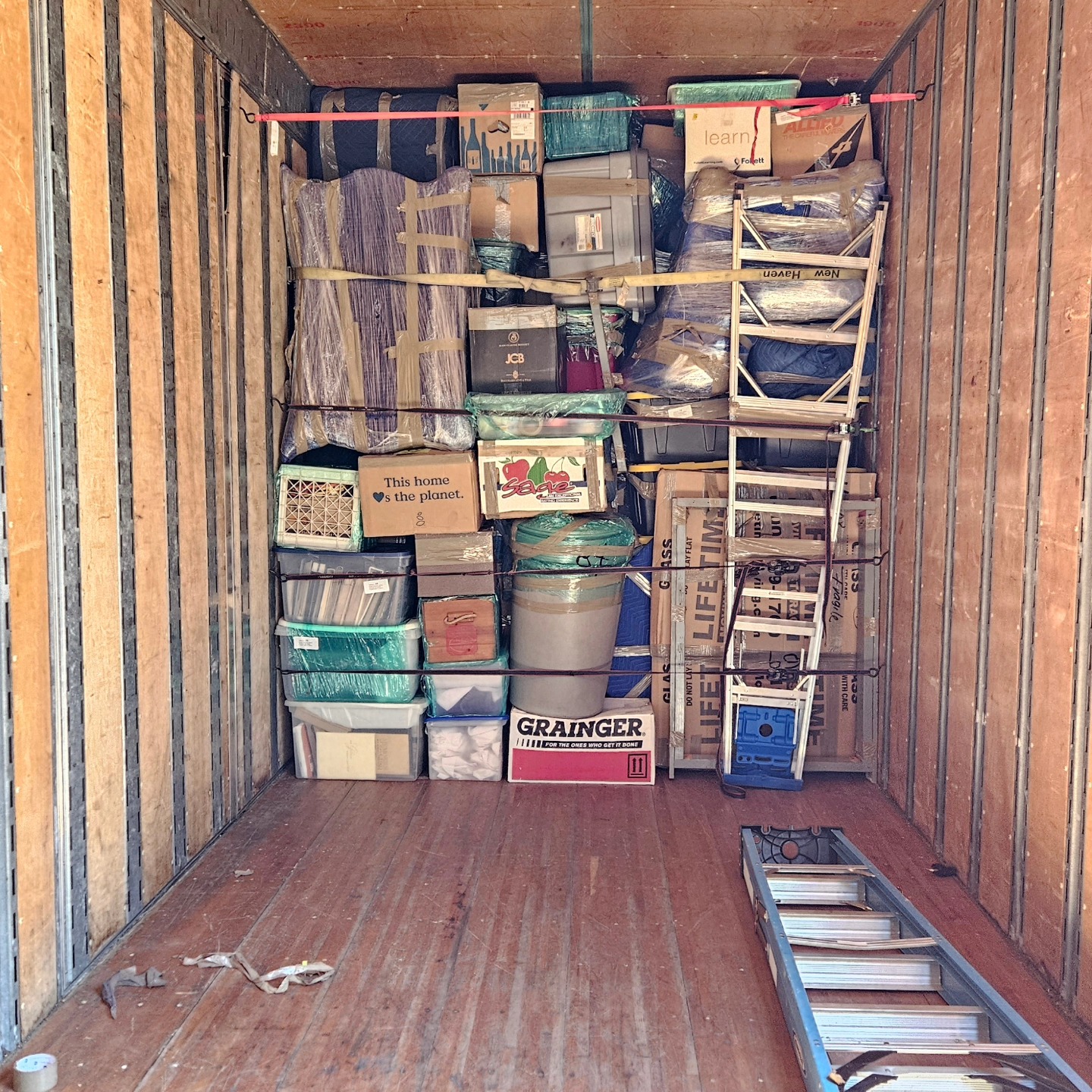
"That is a perfect stack"
A fully loaded trailer, wall to wall: wrapped furniture, stacked boxes and containers, ladders strapped in. "I wish all the jobs looked like that" — this is what the cubic feet in this guide actually look like.
View on Instagram →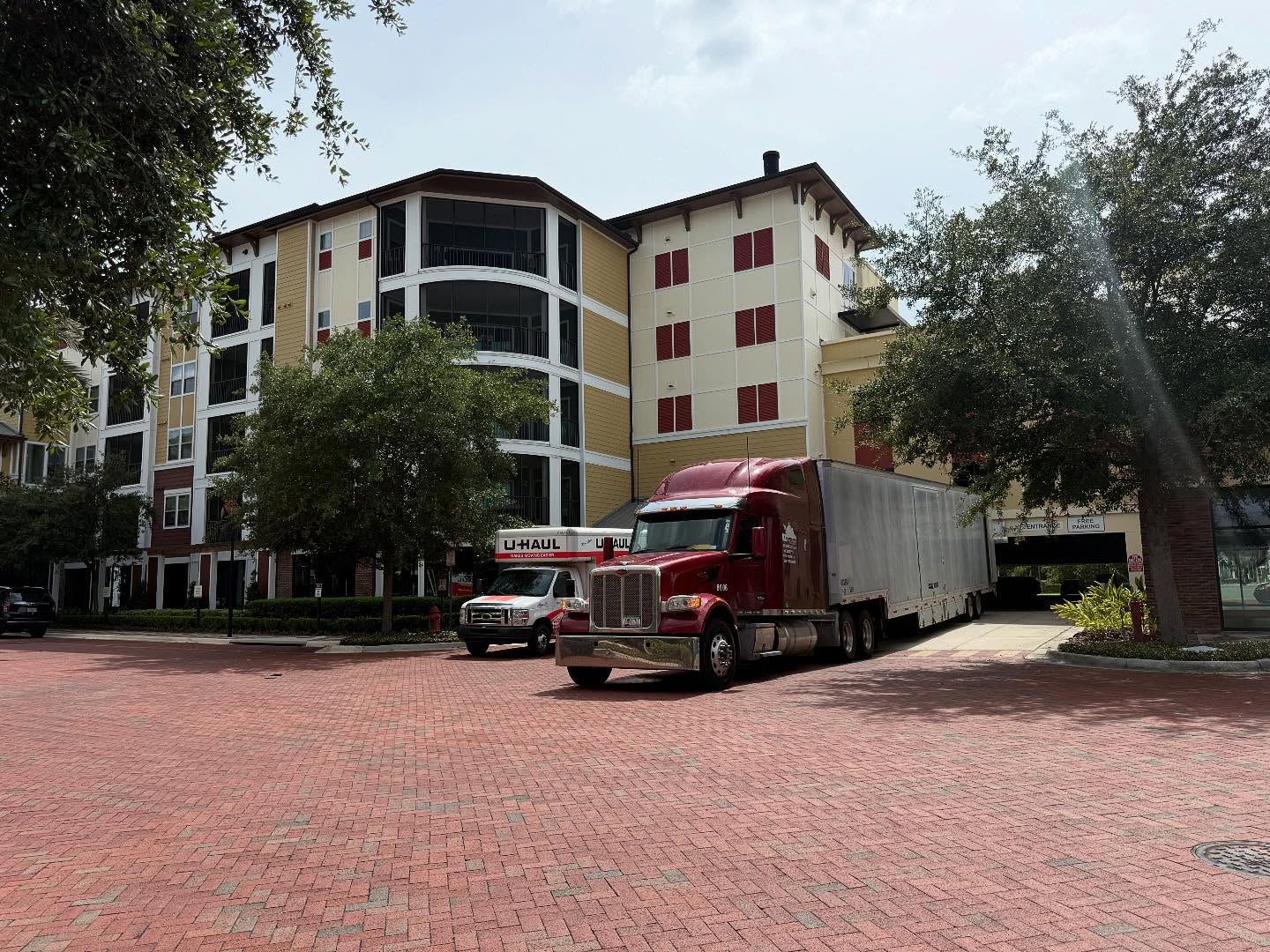
"Get my stuff moved from Texas to Florida"
The semi on the brick driveway, loaded for the long run from Texas to Florida — another household covered, door to door.
View on Instagram →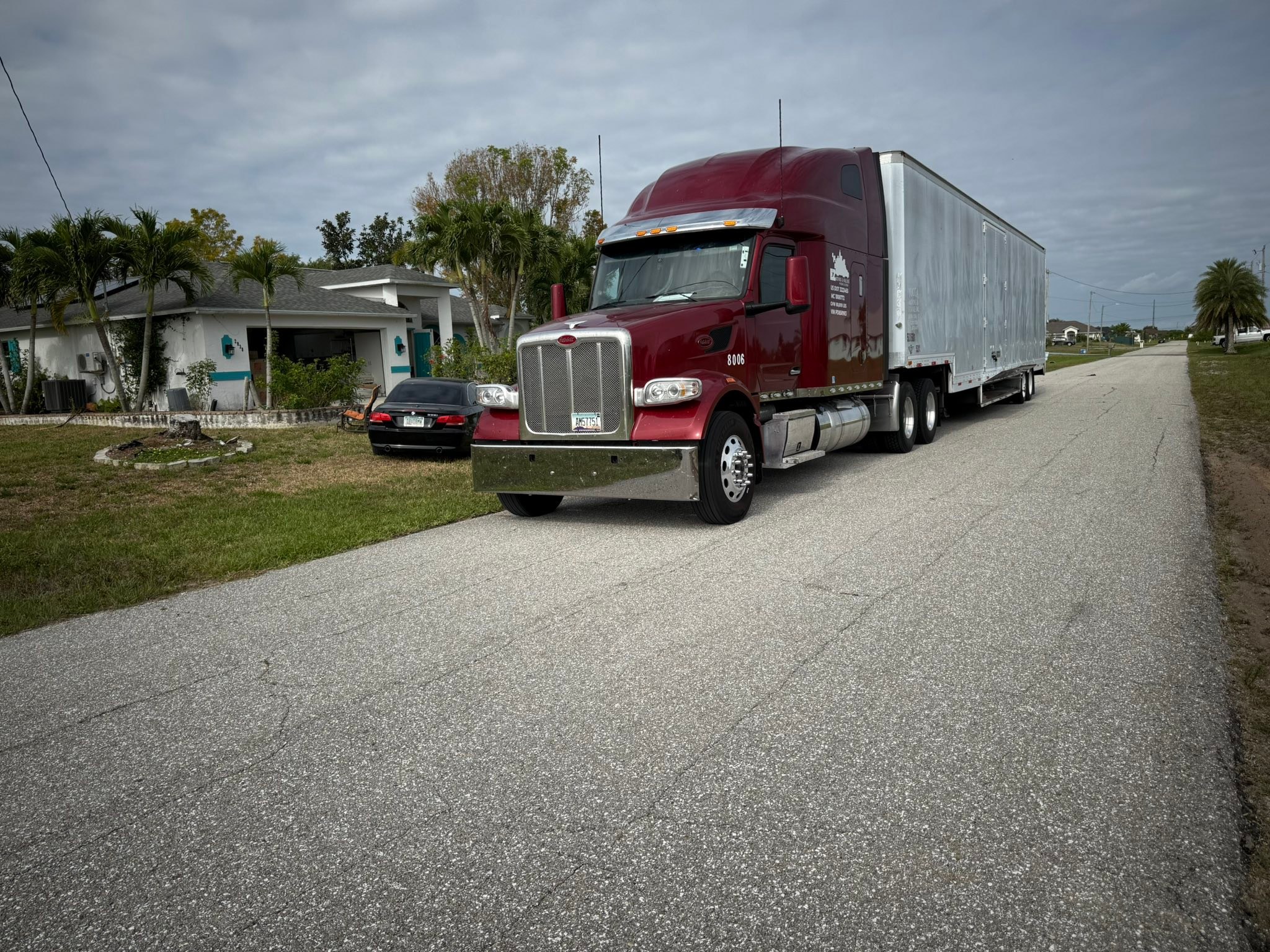
Half a semi unloaded in 4 hours
Another one in the books — half a semi unloaded in four hours, everything put back together, all parties happy.
View on Instagram →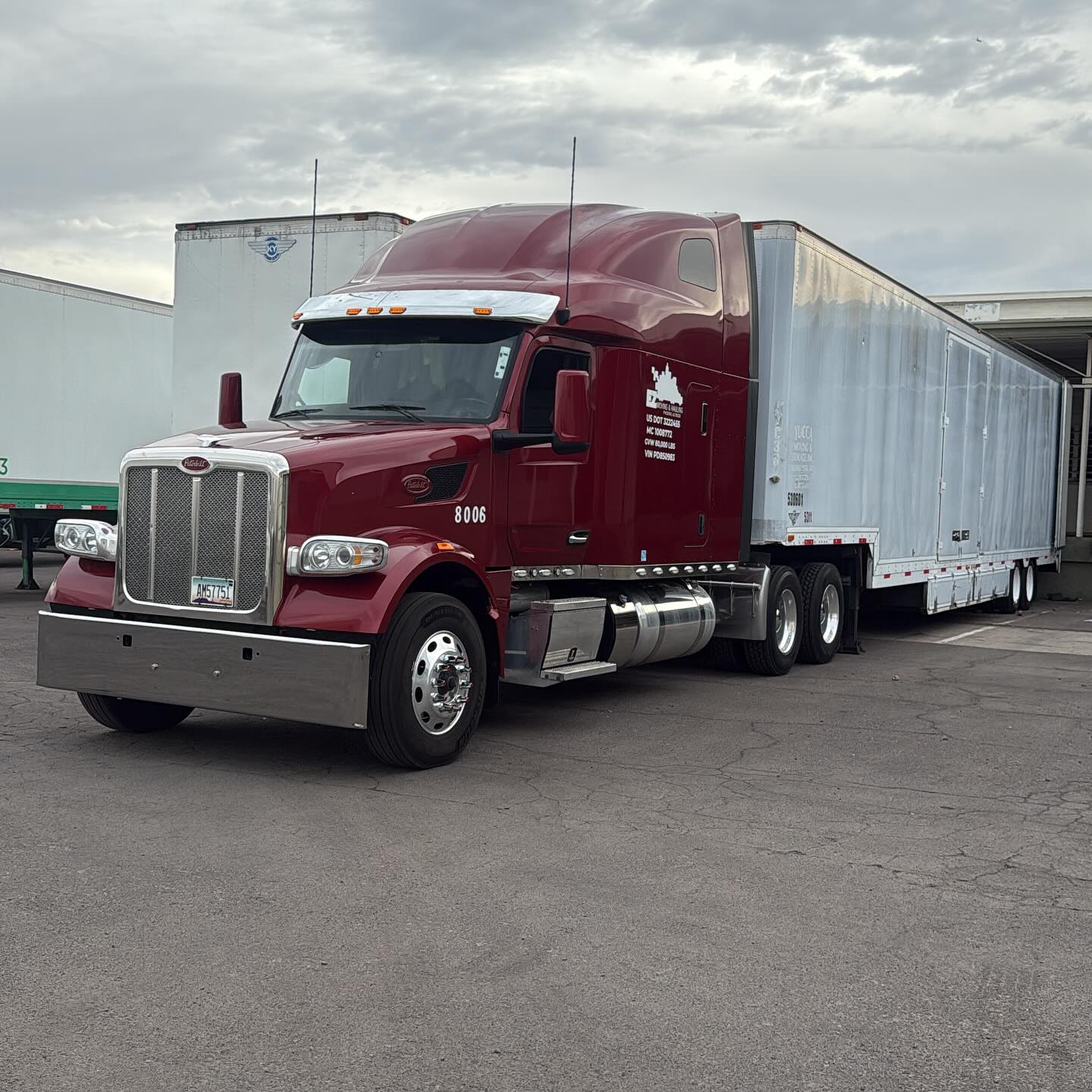
All dolled up, ready for Florida
The truck cleaned up and ready to eat some asphalt — heading back to Florida for the first time in six months, in the middle of a busy moving season.
View on Instagram →
On a country road, at the house
8006 and the moving trailer on a quiet paved road, stopped below a stone house set back among the trees.
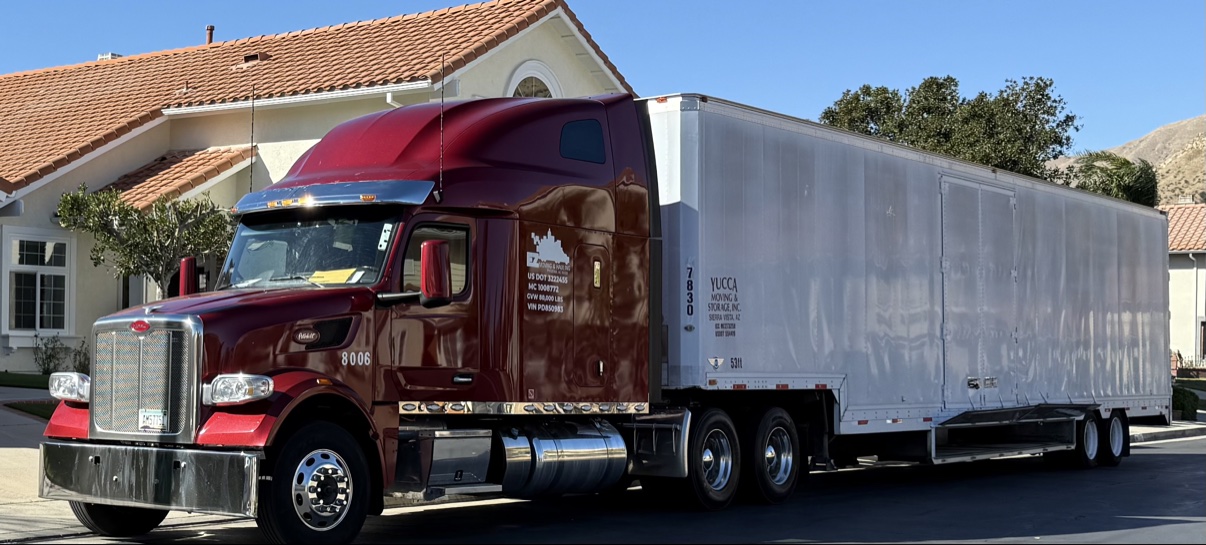
Curbside at a tile-roof house
8006 parked in front of a suburban house with a tile roof, the silver trailer ready for the load on a clear, sunny day.
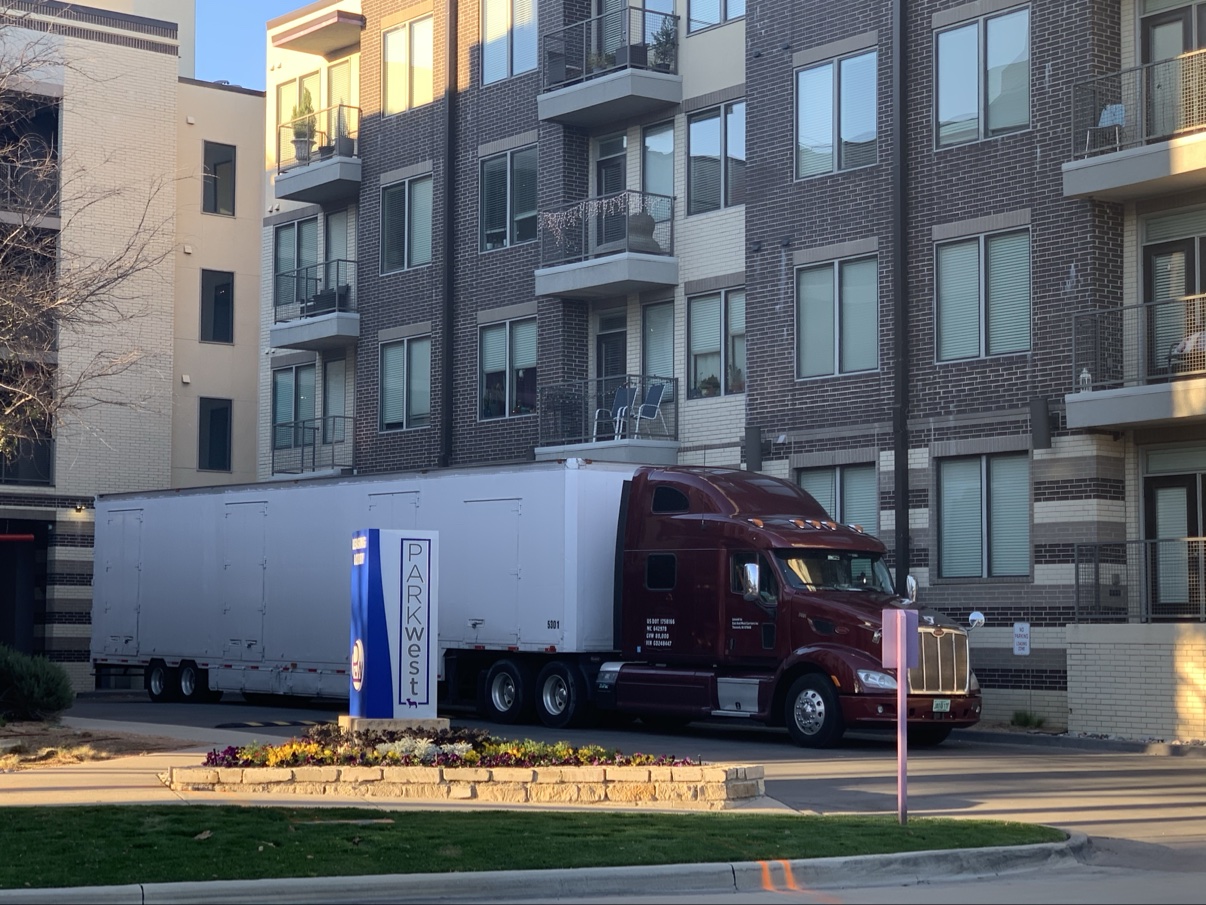
Fitted in at the apartments
The semi worked in tight at the Park West apartments — a full-size trailer at a brick apartment building, balconies overhead.
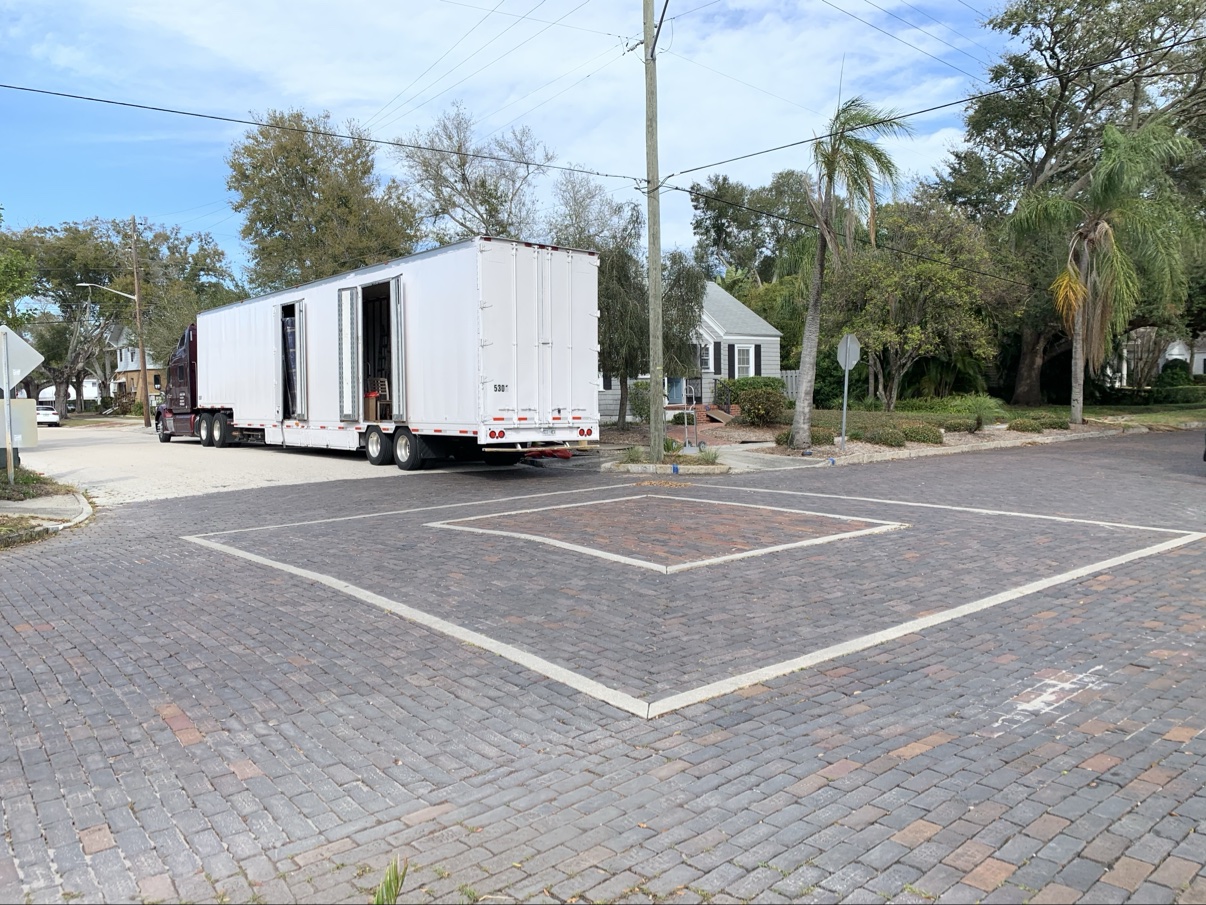
Side doors open on a brick street
The trailer spotted on a brick-paved corner with its side doors open for loading, palm trees and a small house just across the street.
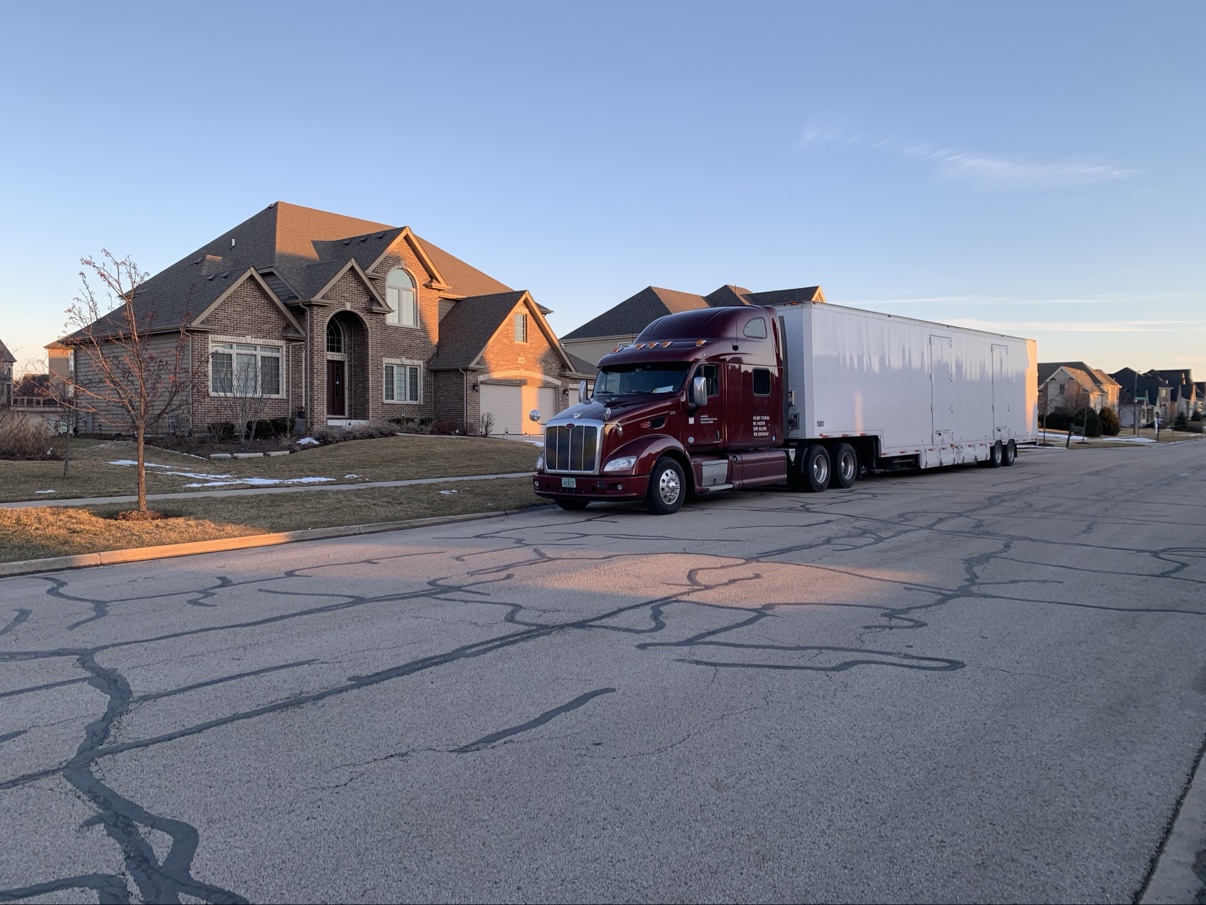
At a brick house at sundown
8006 parked on the street in front of a large brick house in the late-day light, patches of snow still on the lawn.
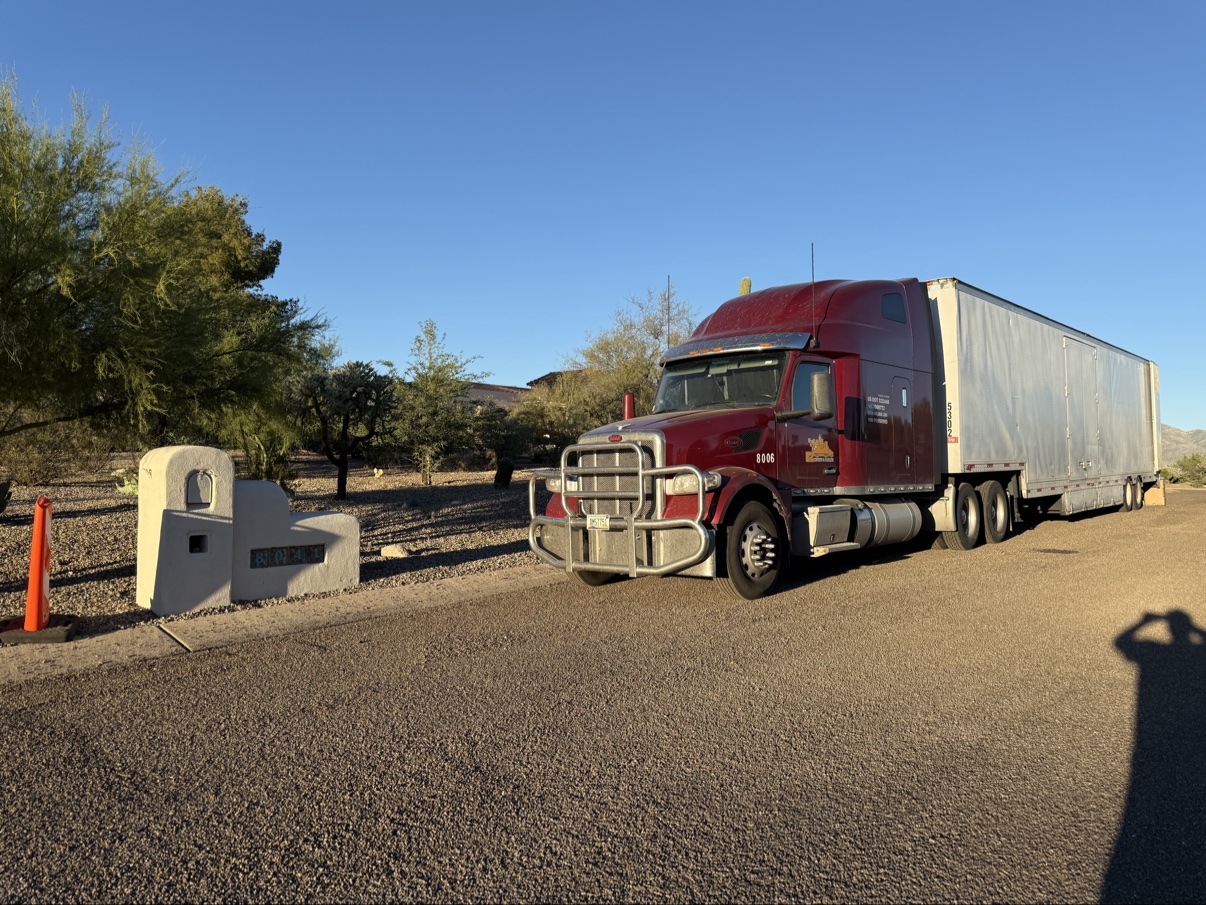
At a desert home
8006 at the curb of a desert-landscaped home, parked by the stucco mailbox with cactus and mesquite all around.

Tucked into the loading dock
The semi tucked into the loading dock at the Inscription apartments — a big rig working a modern apartment building in the city.
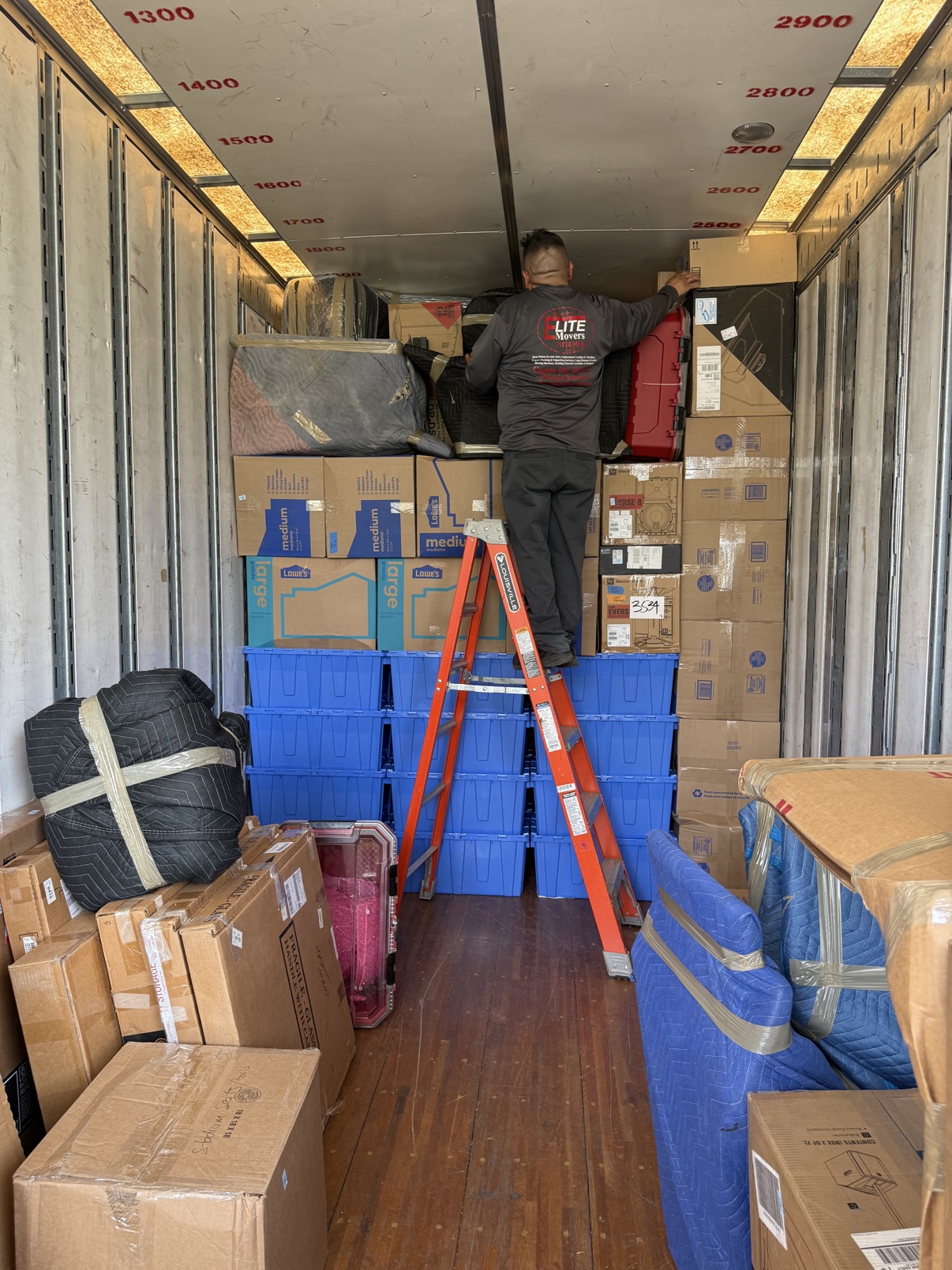
Stacking the load to the ceiling
Inside the trailer mid-load: a crew member on a ladder topping off the stack — blue bins, boxes and padded furniture — with the cubic-feet markings running along the ceiling overhead.
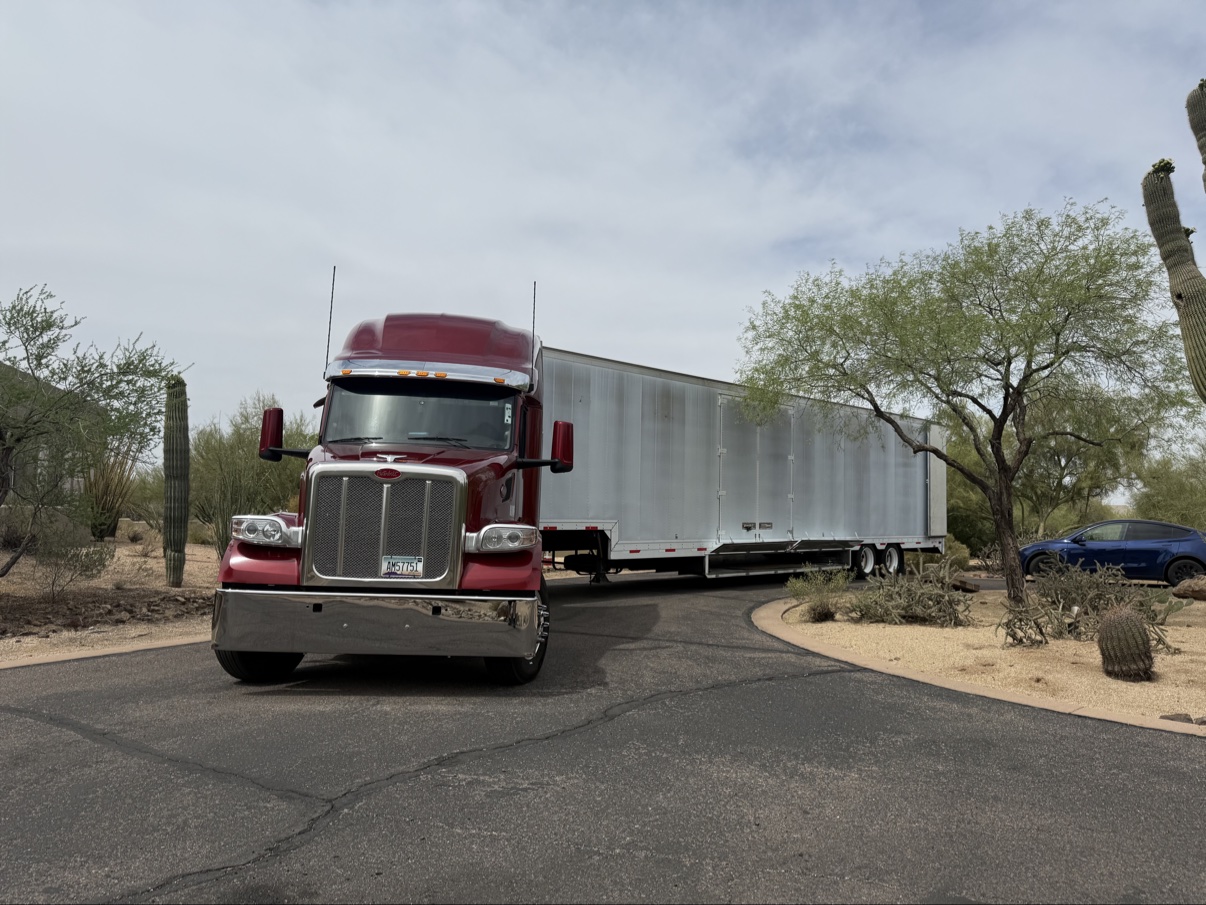
Around the desert curve
8006 bringing the trailer around a curved desert road, saguaro cactus and desert brush on both sides.
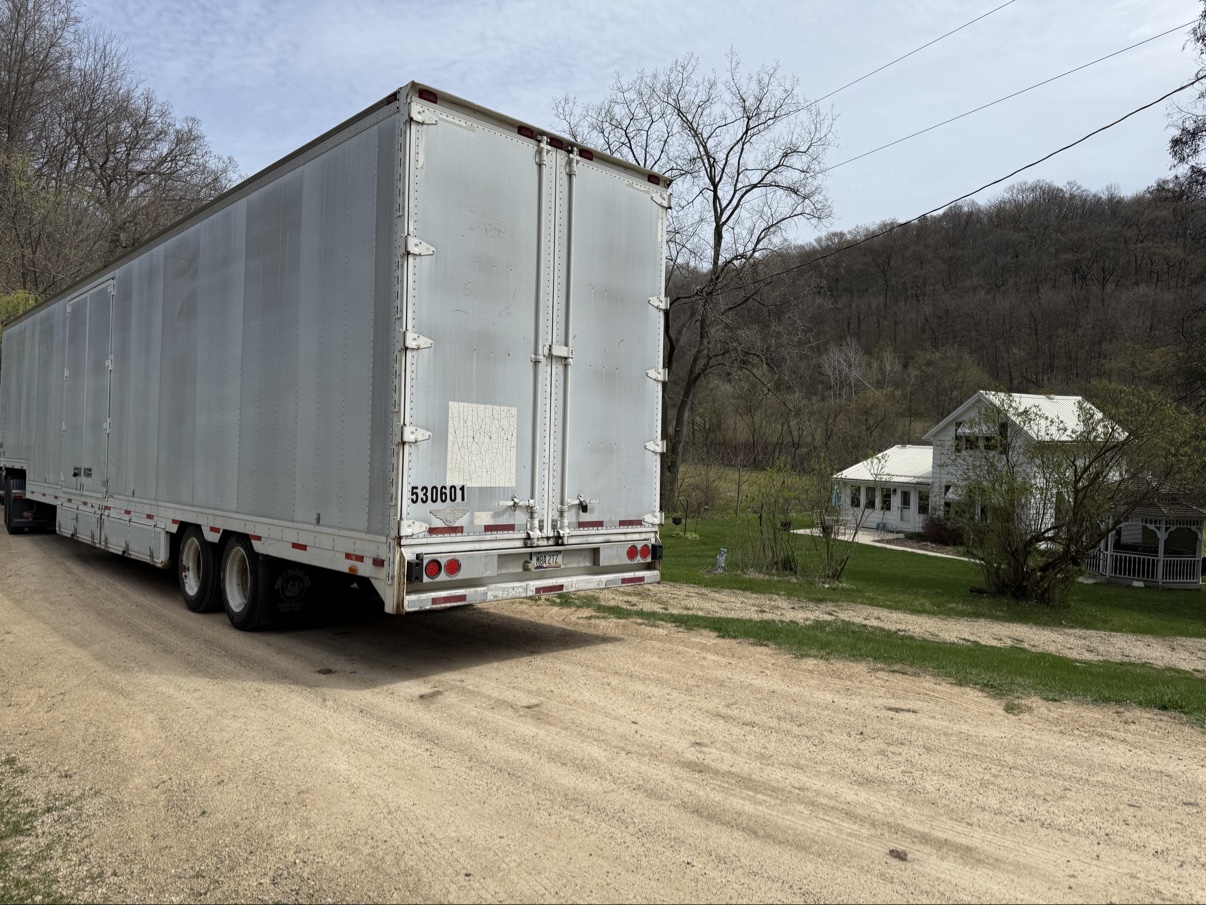
Down a dirt road to a farmhouse
The back of the trailer on a dirt road, pulled up at a white farmhouse with wooded hills behind it.
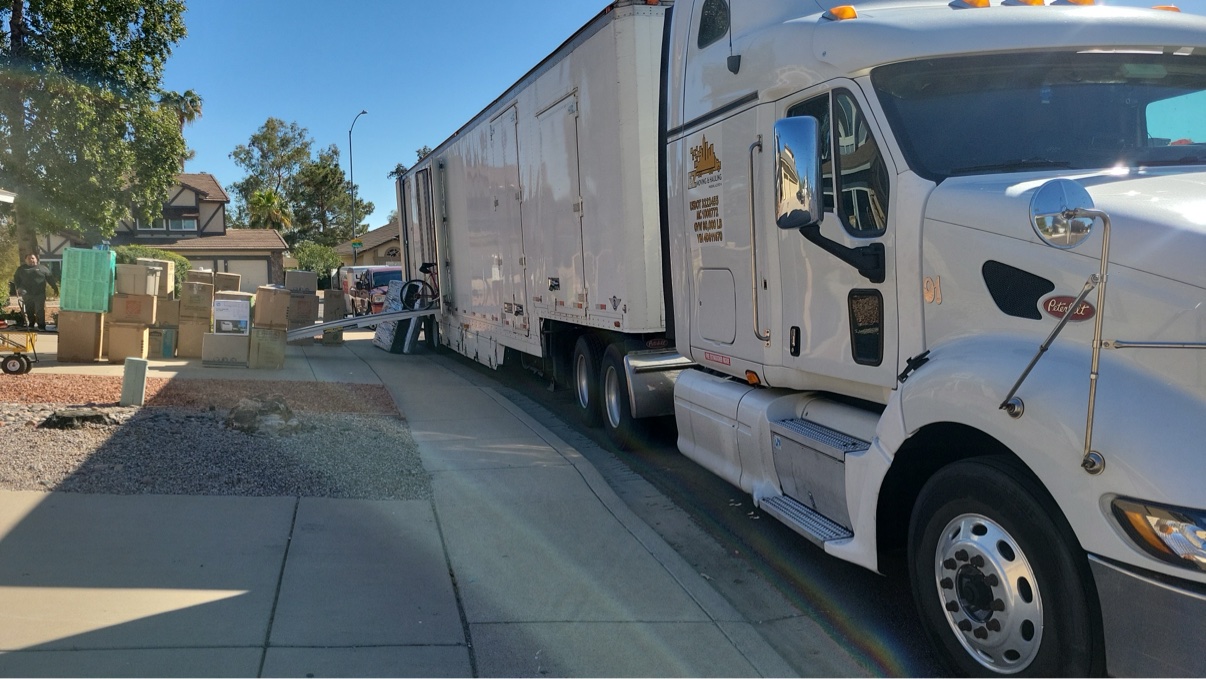
Boxes staged, ramp down
The white Peterbilt at a house with the ramp down and boxes staged on the driveway — mid-load on a sunny suburban street.
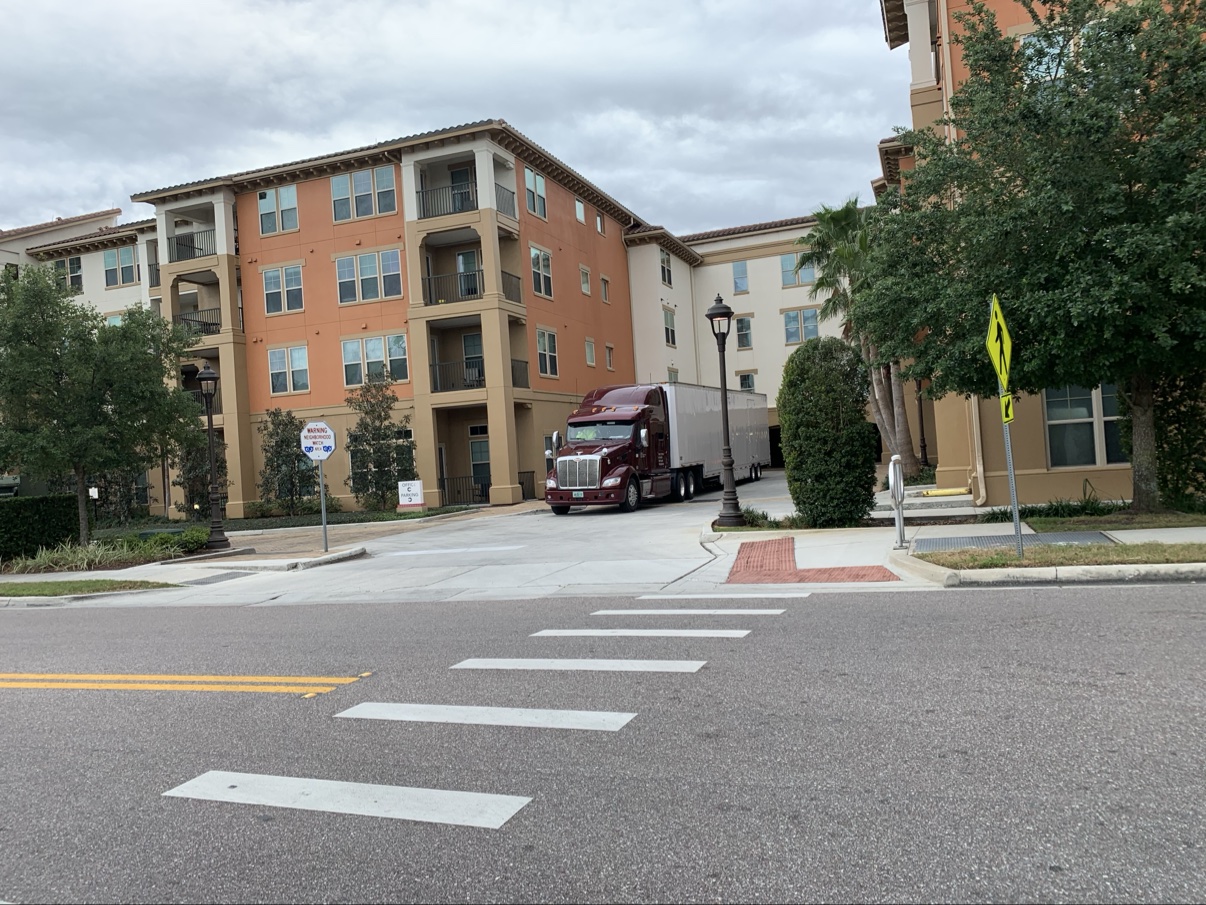
In at the apartment complex
8006 worked into the drive at a peach-colored apartment complex — a full-size semi at the building, seen from across the crosswalk.
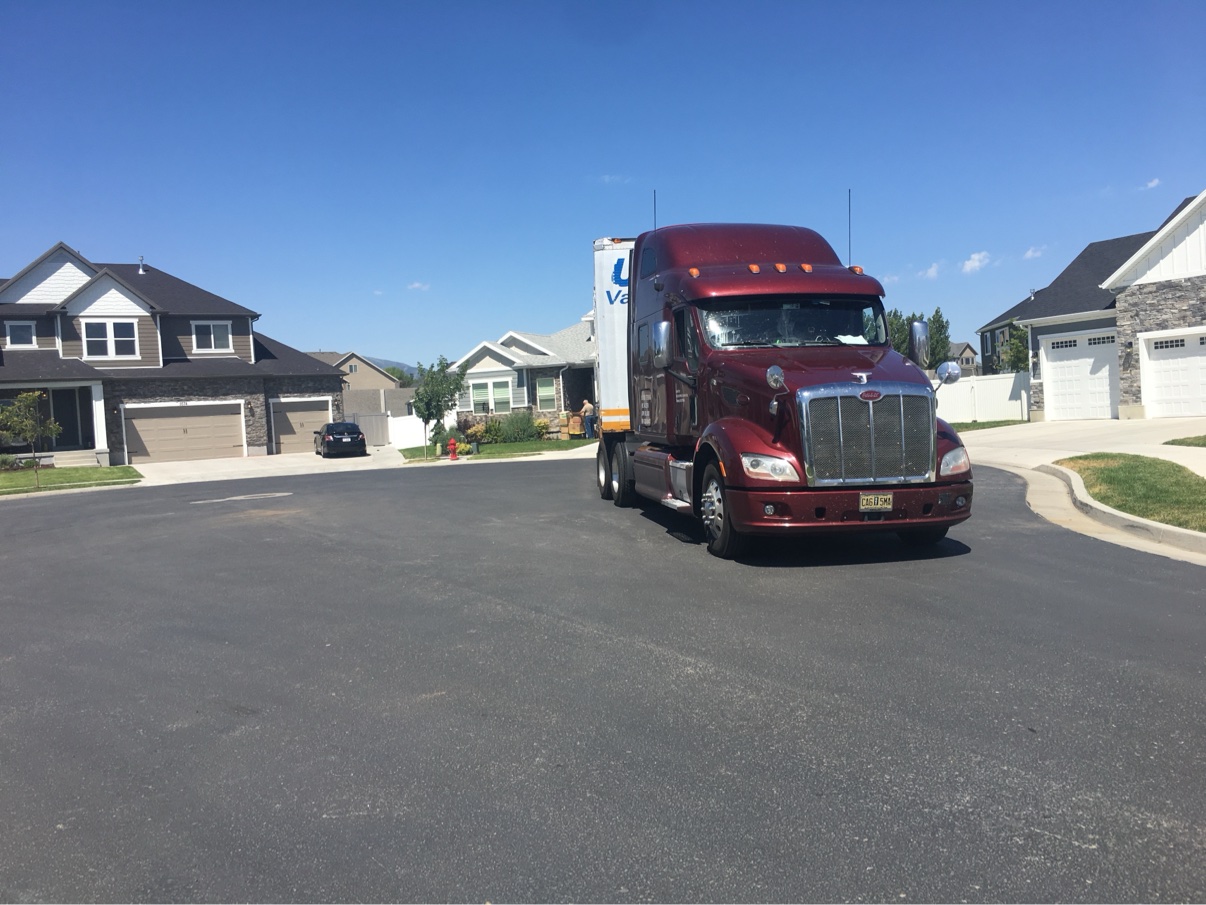
On a suburban street
The maroon Peterbilt on a wide, quiet cul-de-sac, houses on both sides — another neighborhood move under a clear blue sky.
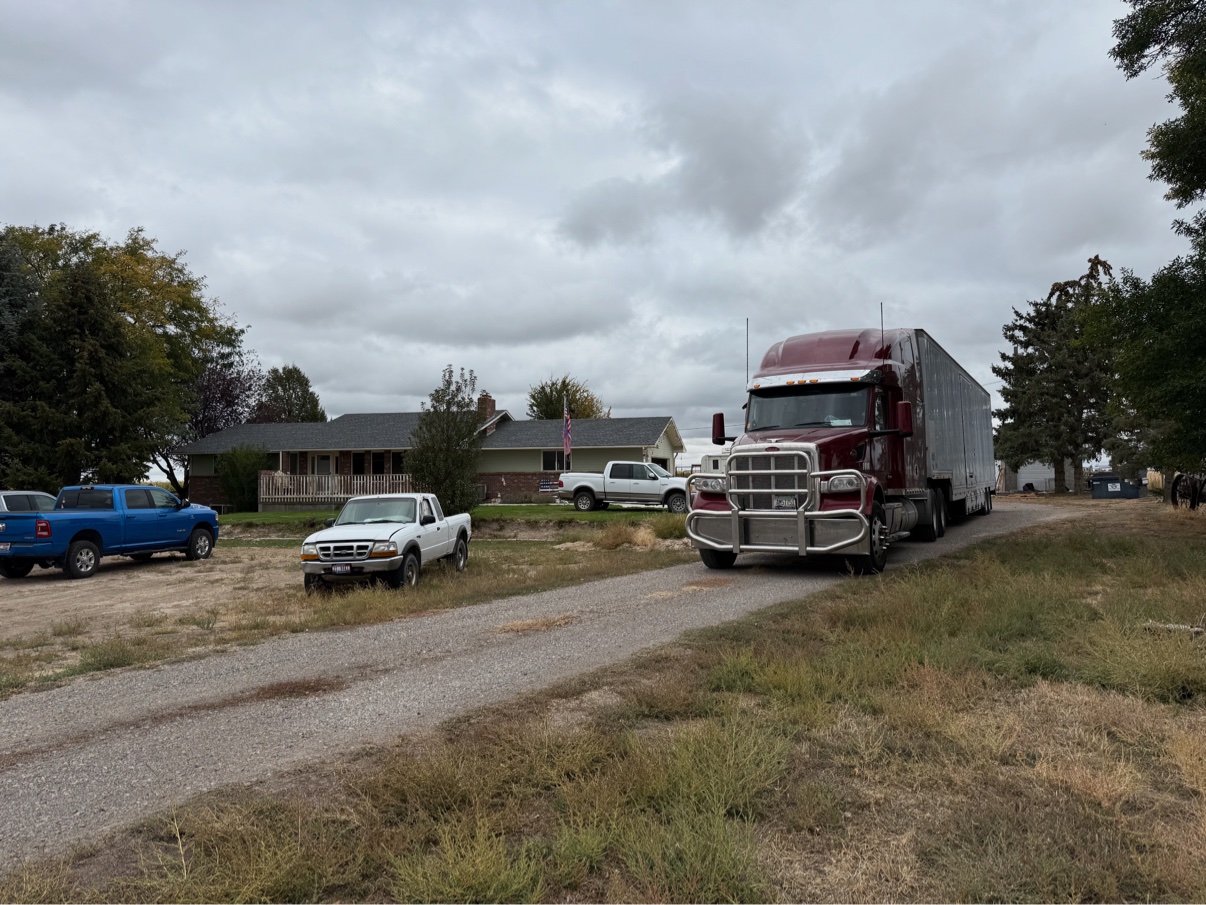
At a rural house on a cloudy day
8006 on the gravel drive at a rural house, the moving trailer behind it under a gray, cloudy sky.

Just another day in the country
8006 on the dirt road at a white country house — the photo says it best: "Just another day in the country..."
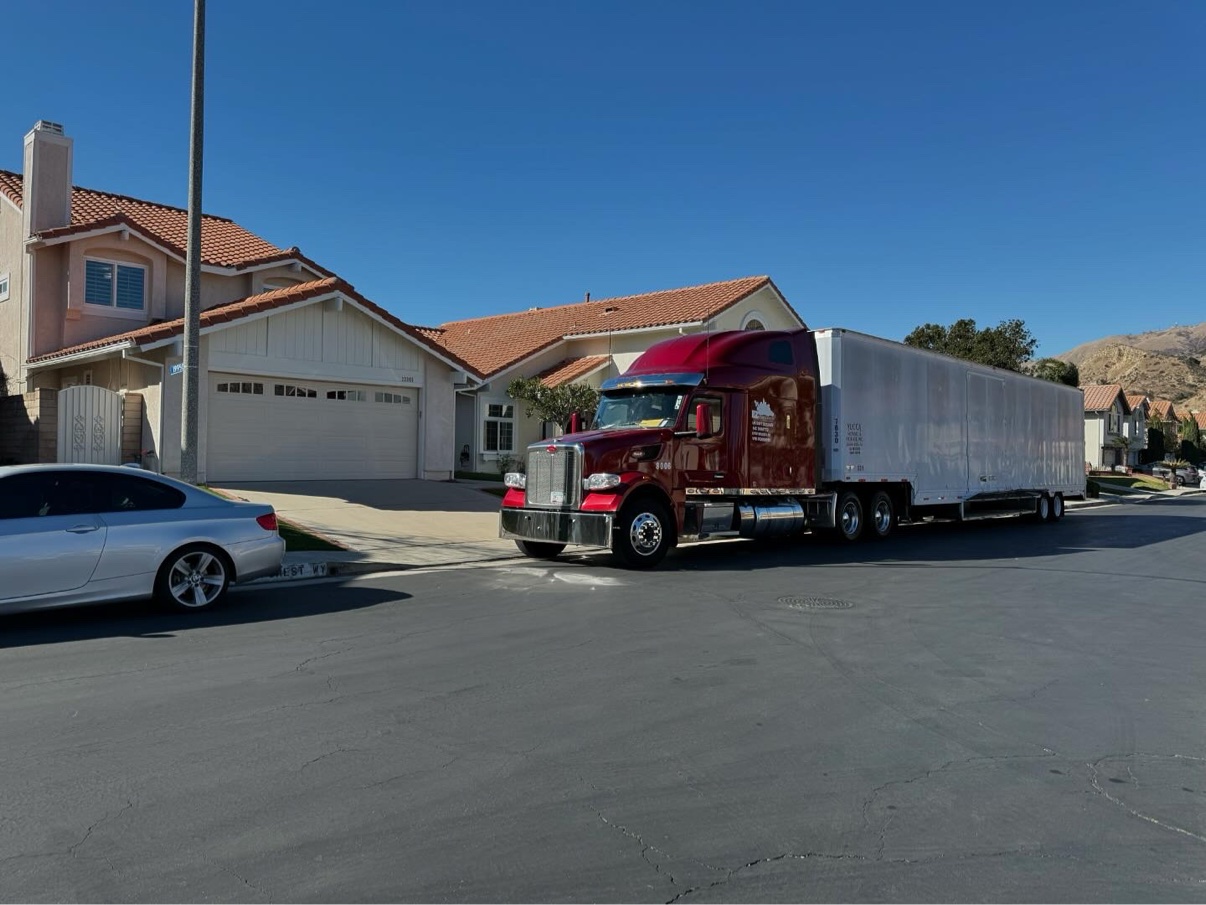
At a suburban house, full sun
8006 and the moving trailer at the curb of a suburban house with a red tile roof, under a clear blue sky.
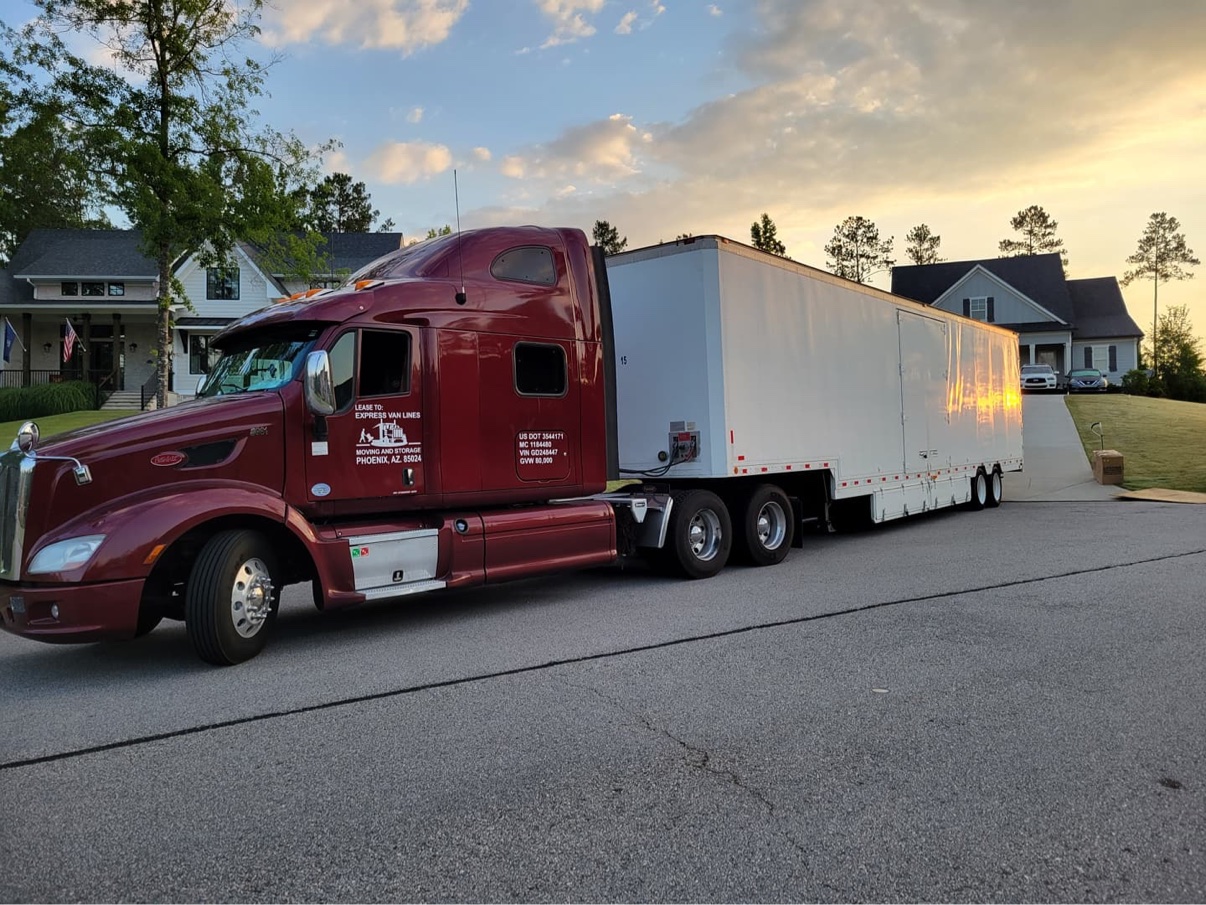
At a house at sunset
8006 and the white moving trailer at the curb as the sun goes down, golden light catching the side of the trailer.

At the end of a long driveway
8006 at the far end of a long driveway, with the crew walking up toward the house to get the job going.
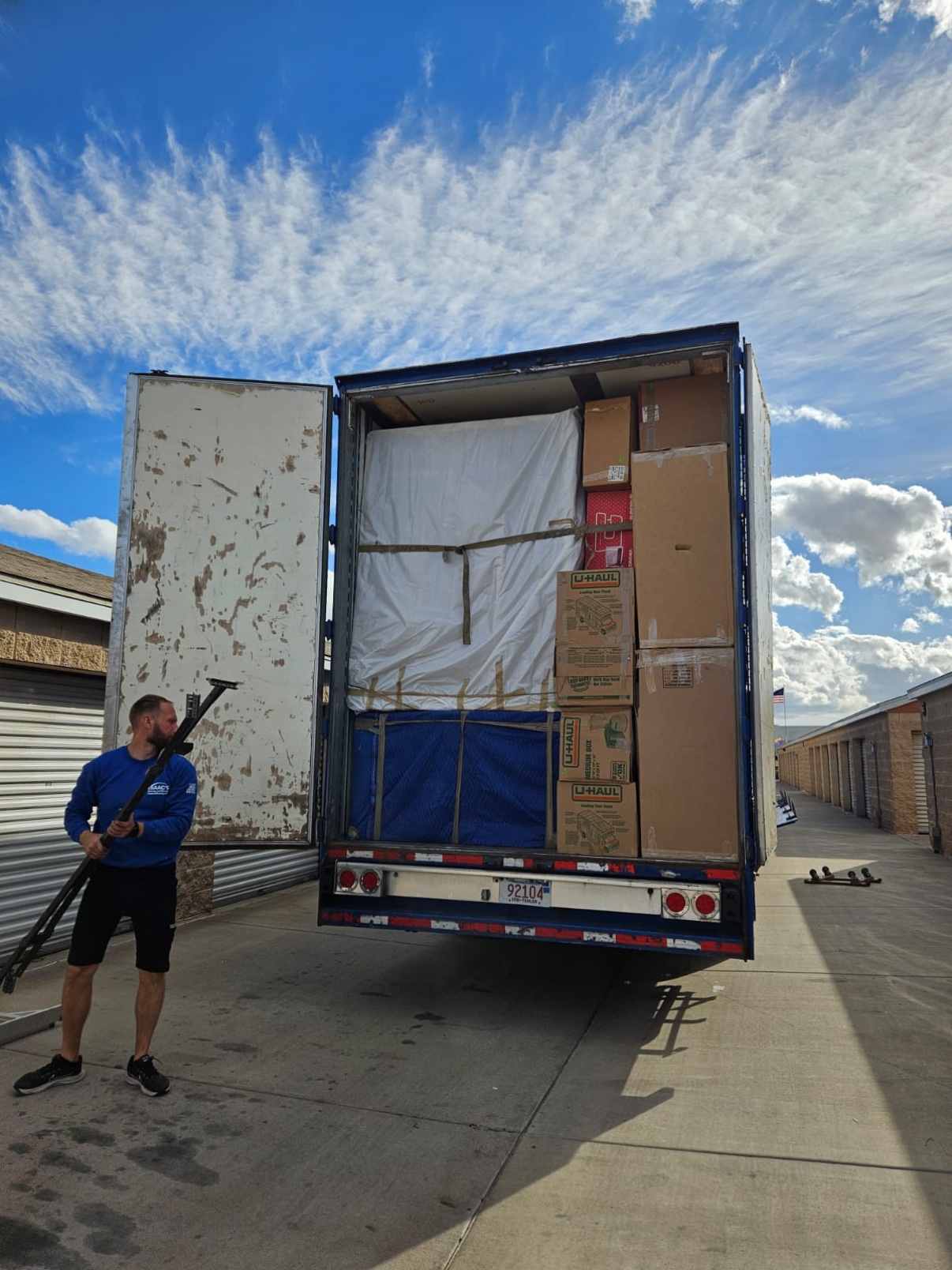
Doors open at the storage facility
The trailer backed in at the storage facility, fully loaded with doors open — a crew member getting the gear ready to unload.
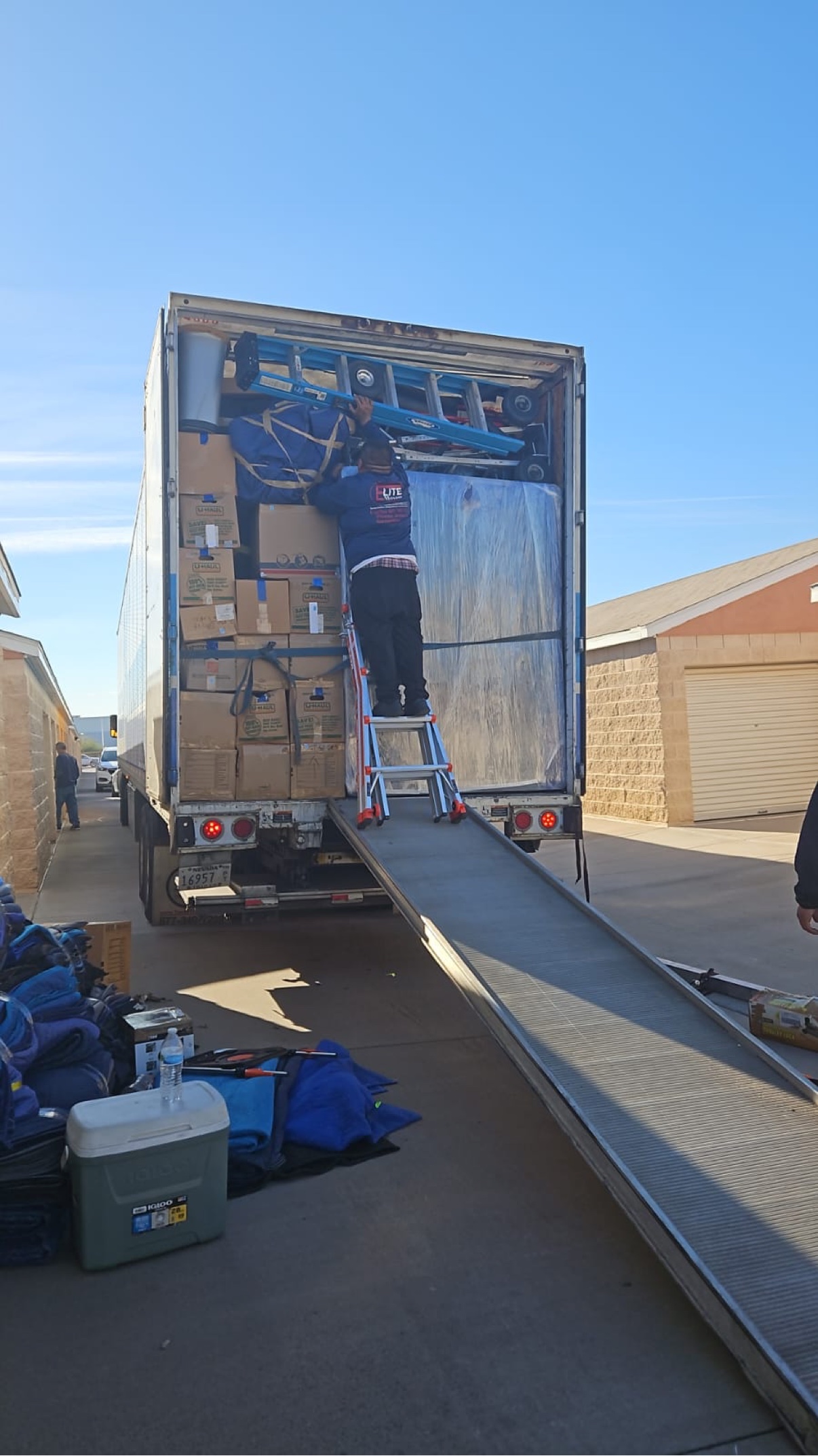
Up the ladder, topping off the load
A crew member on the ladder at the back of the trailer, working at a storage facility — boxes stacked high and the last gear going in up top.
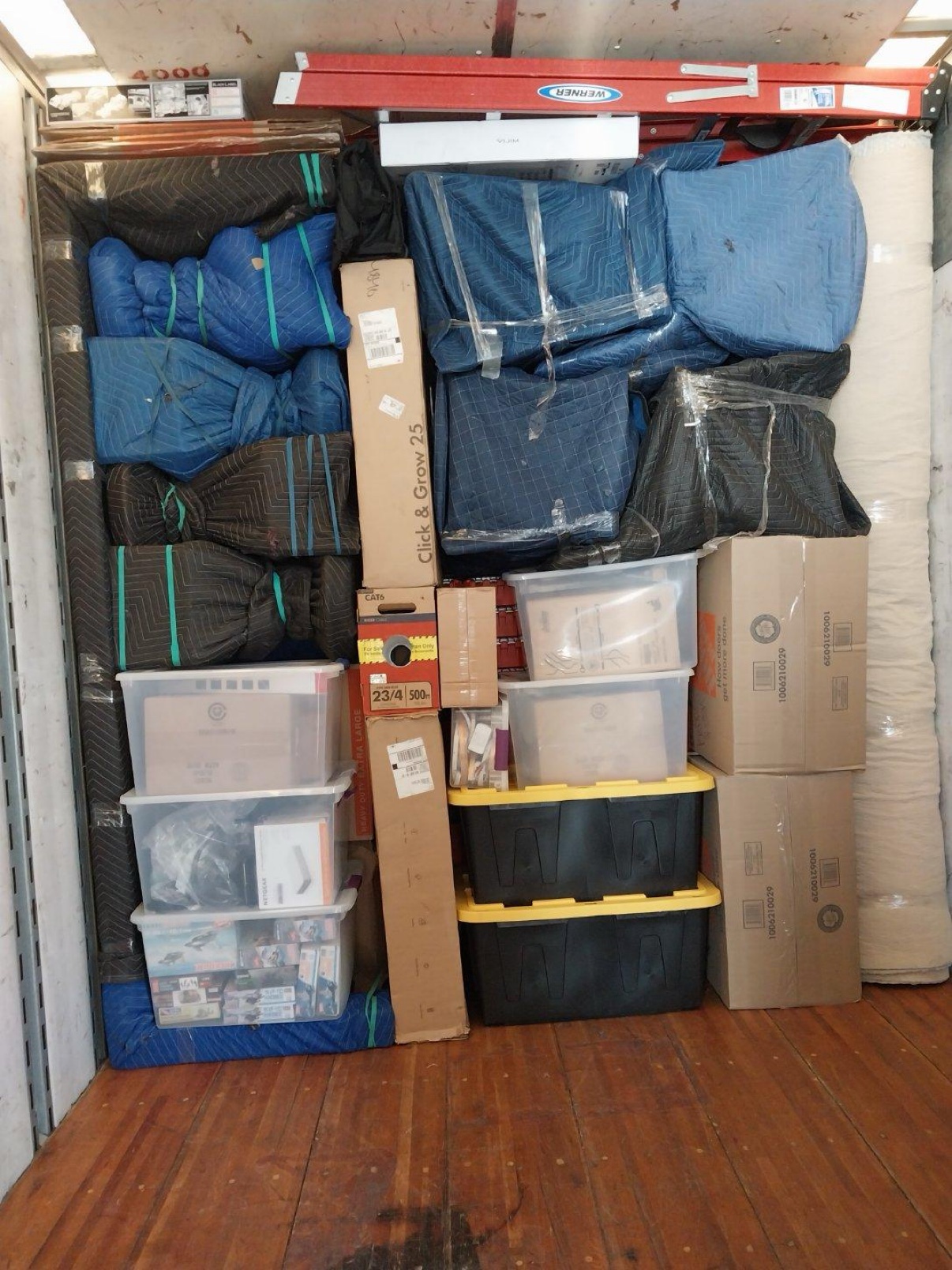
Packed tight, floor to ceiling
Inside the trailer: padded furniture, boxes and bins stacked in tight with no wasted space — the way a load should ride.
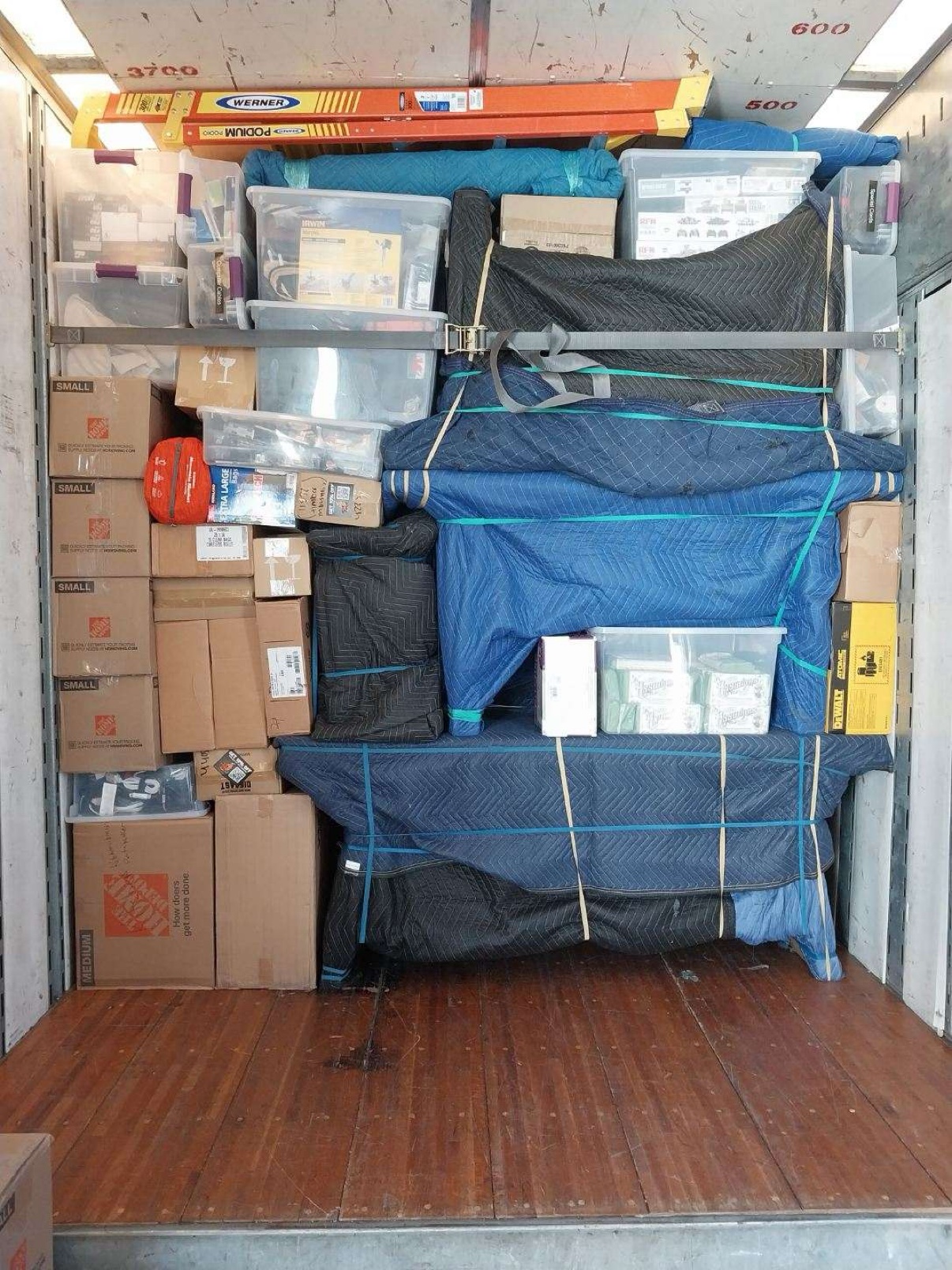
Read the markings over the load
Another tight load, wall to wall — and the cubic-feet markings right there on the ceiling, so the space the load takes is plain to see.
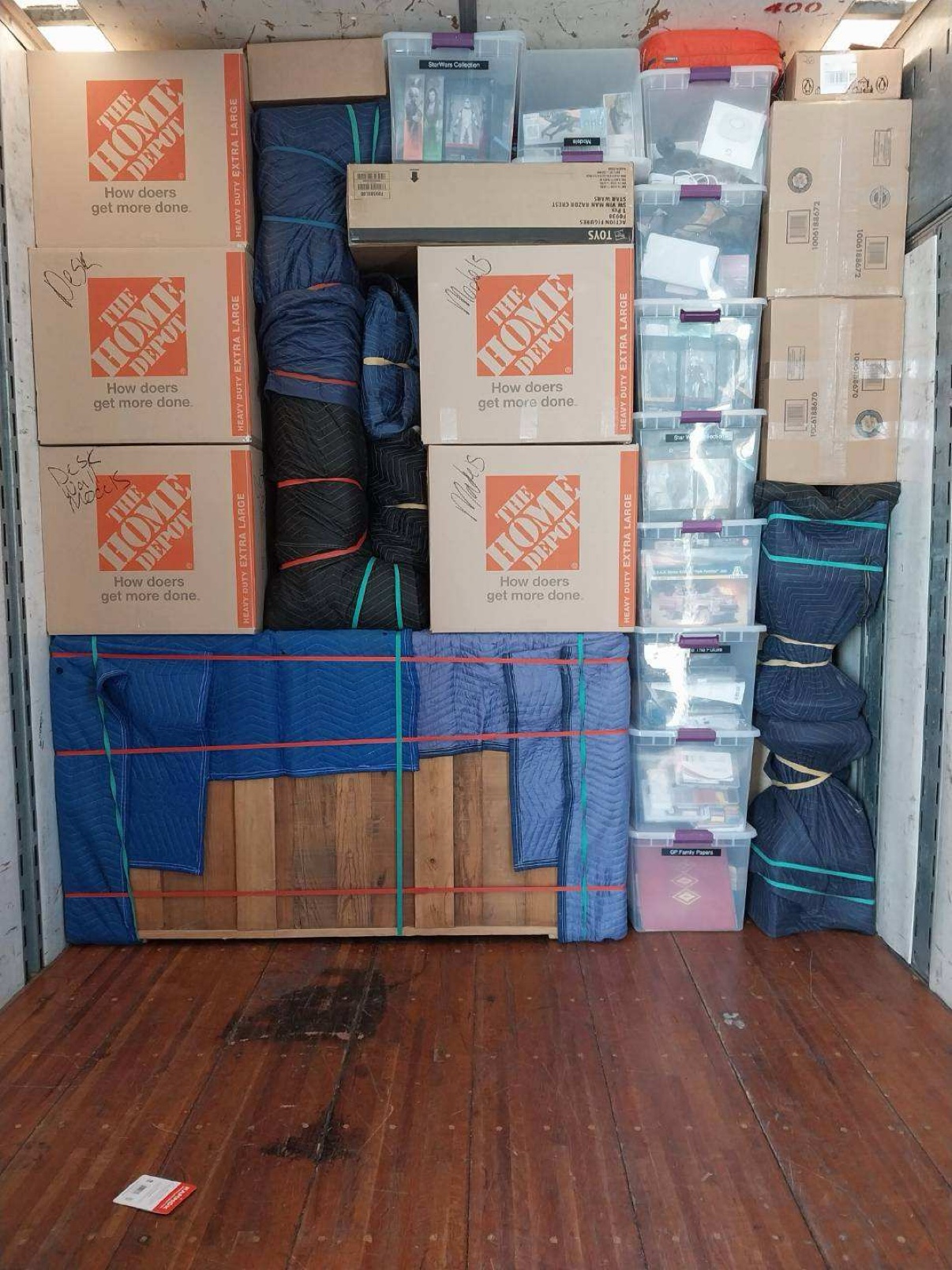
Home Depot boxes, loaded right
Home Depot boxes, bins and pad-wrapped furniture stacked in clean rows — every piece in its place for the ride.
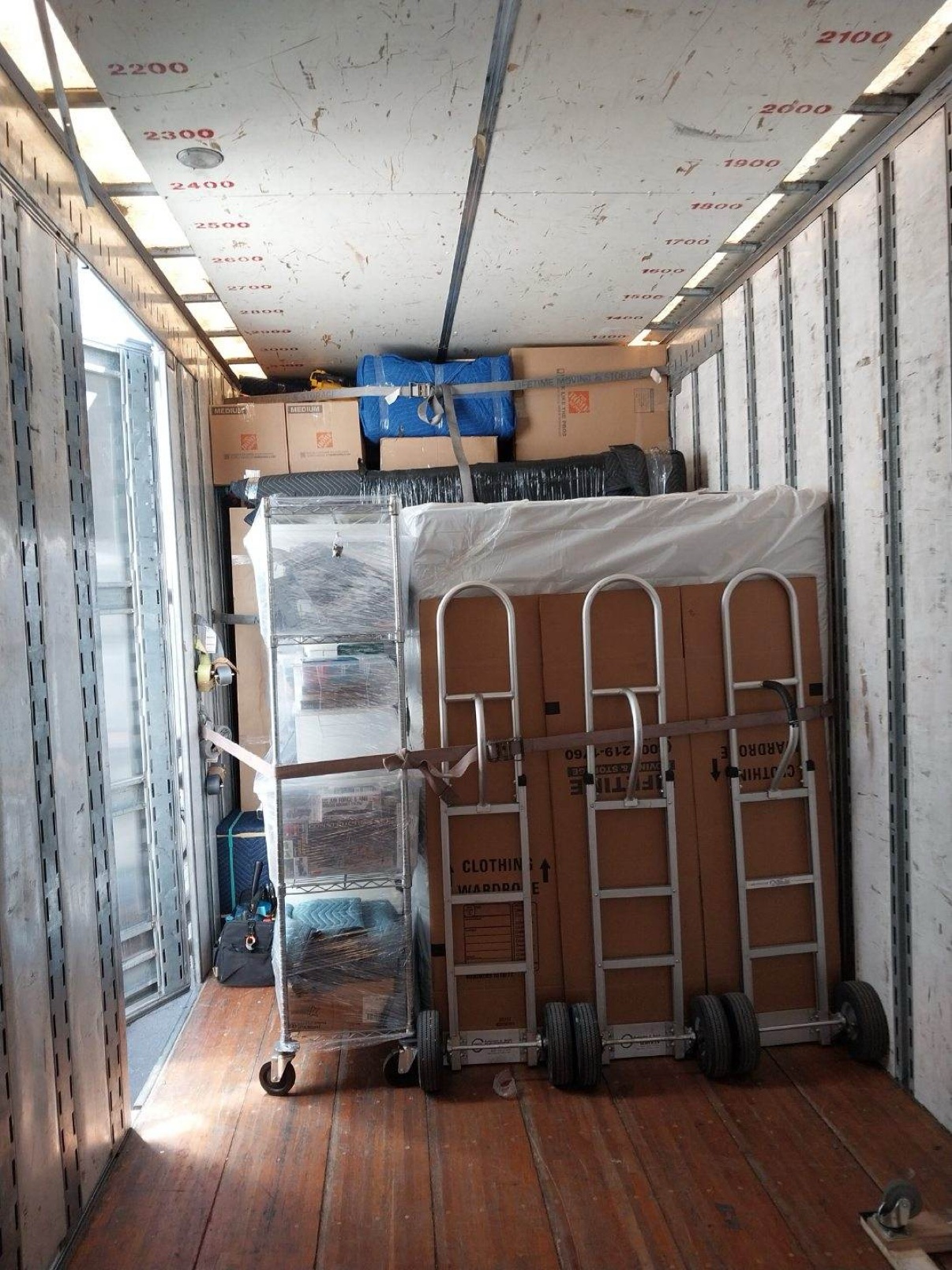
Wardrobes in, dollies ready
Wardrobe boxes strapped in at the front of the load and the dollies lined up ready — with the ceiling markings running overhead.
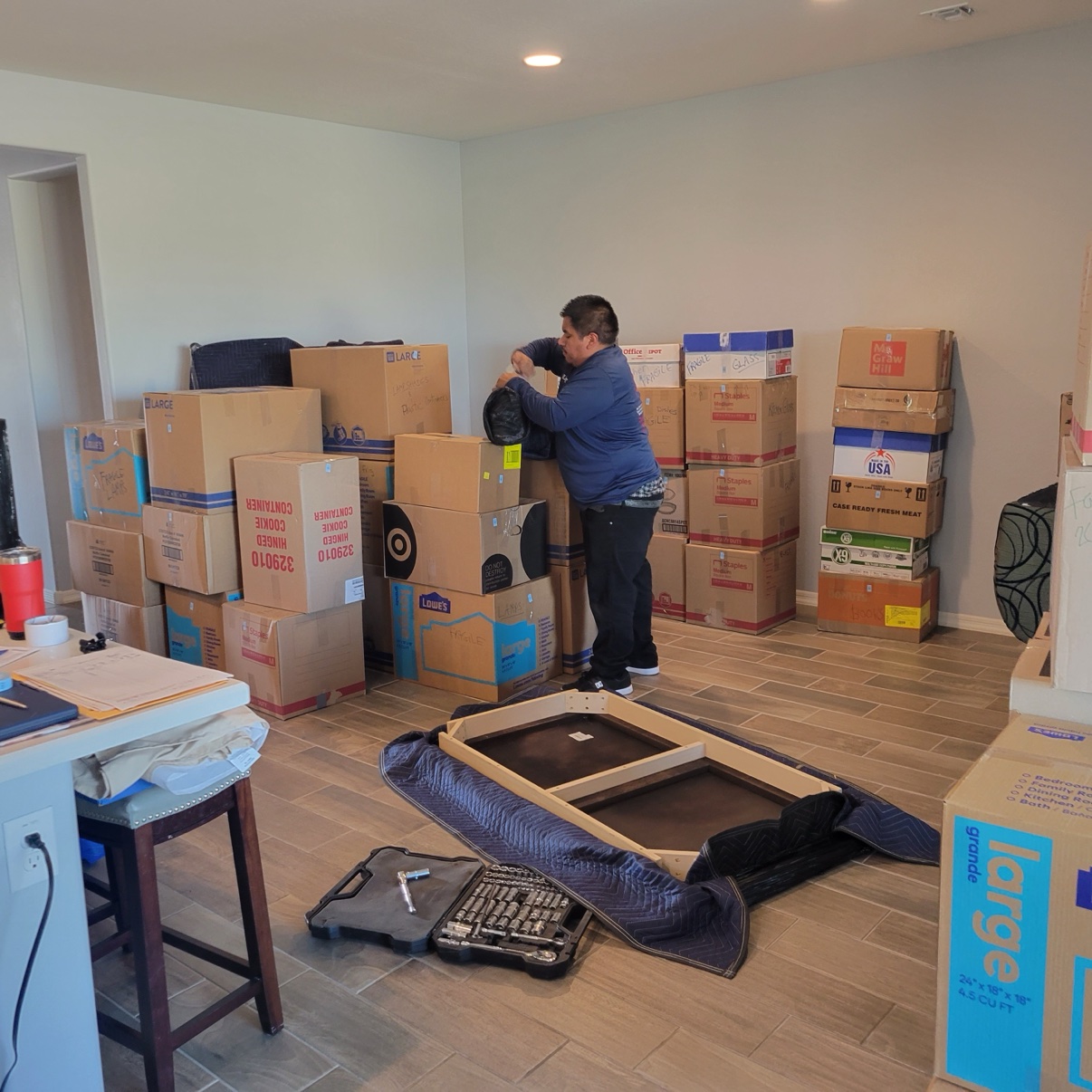
Packing up, table frame down
A crew member packing boxes in a room full of labeled cartons — the table already taken apart, its frame resting on a pad and the tools still out.
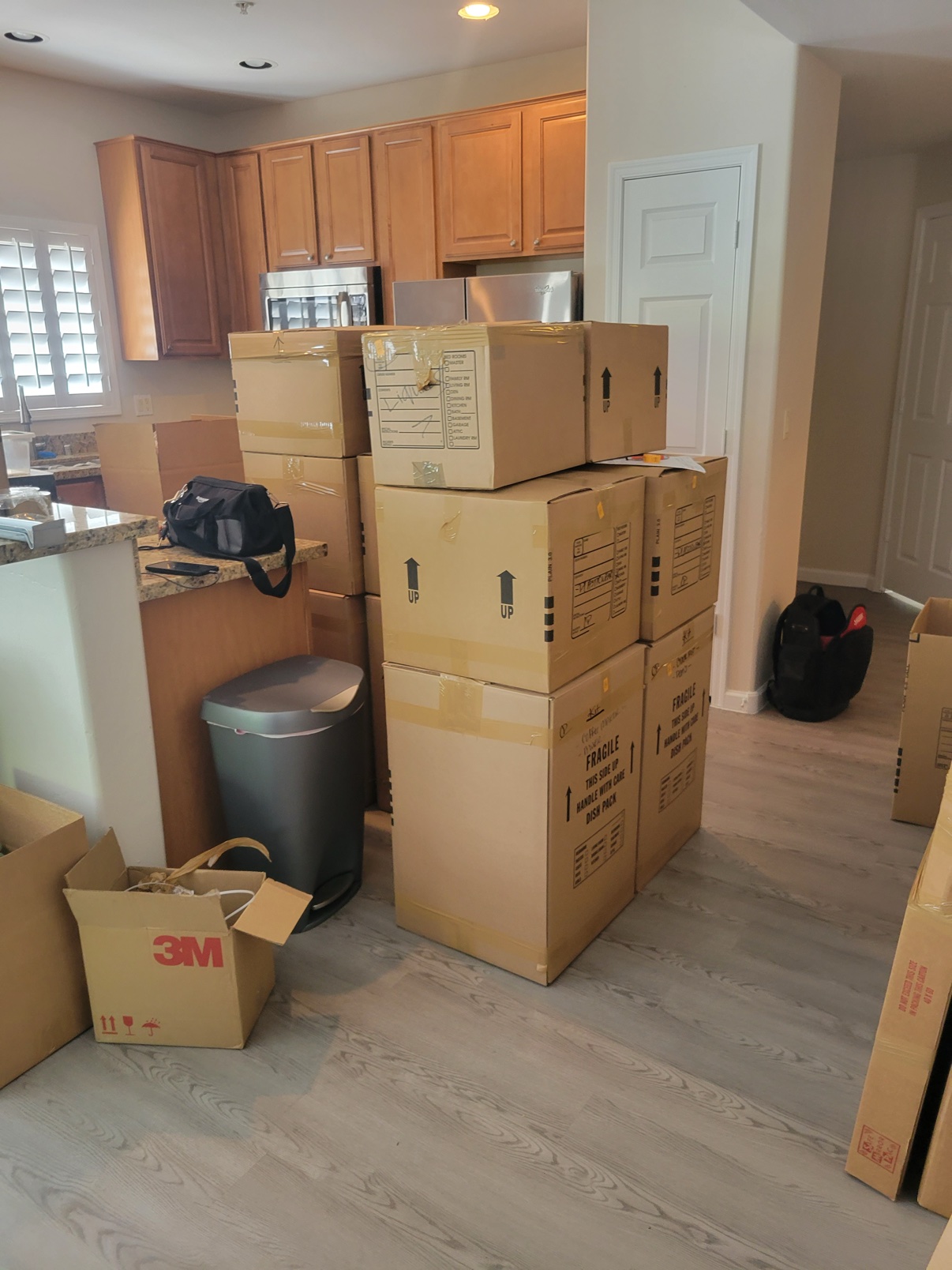
Dish packs stacked in the kitchen
Dish packs and boxes stacked in the kitchen, marked fragile and this side up — the breakables packed the way they're supposed to travel.
Labeled and stacked, ready to go
Boxes labeled and stacked in neat piles — every carton marked with what's inside and where it belongs at the other end.
Glass wrapped, standing tall
A tall glass piece wrapped and taped with care, standing in the hallway ready for the truck — fragile items get protected before they move an inch.
Bedroom boxes by the bed
Labeled bedroom boxes stacked by the bed — clothes, bedding and the rest of the room, each carton marked for where it goes.
Packed, stacked, dolly ready
A stack of packed boxes with the dolly standing by — staged and ready to roll out to the truck.
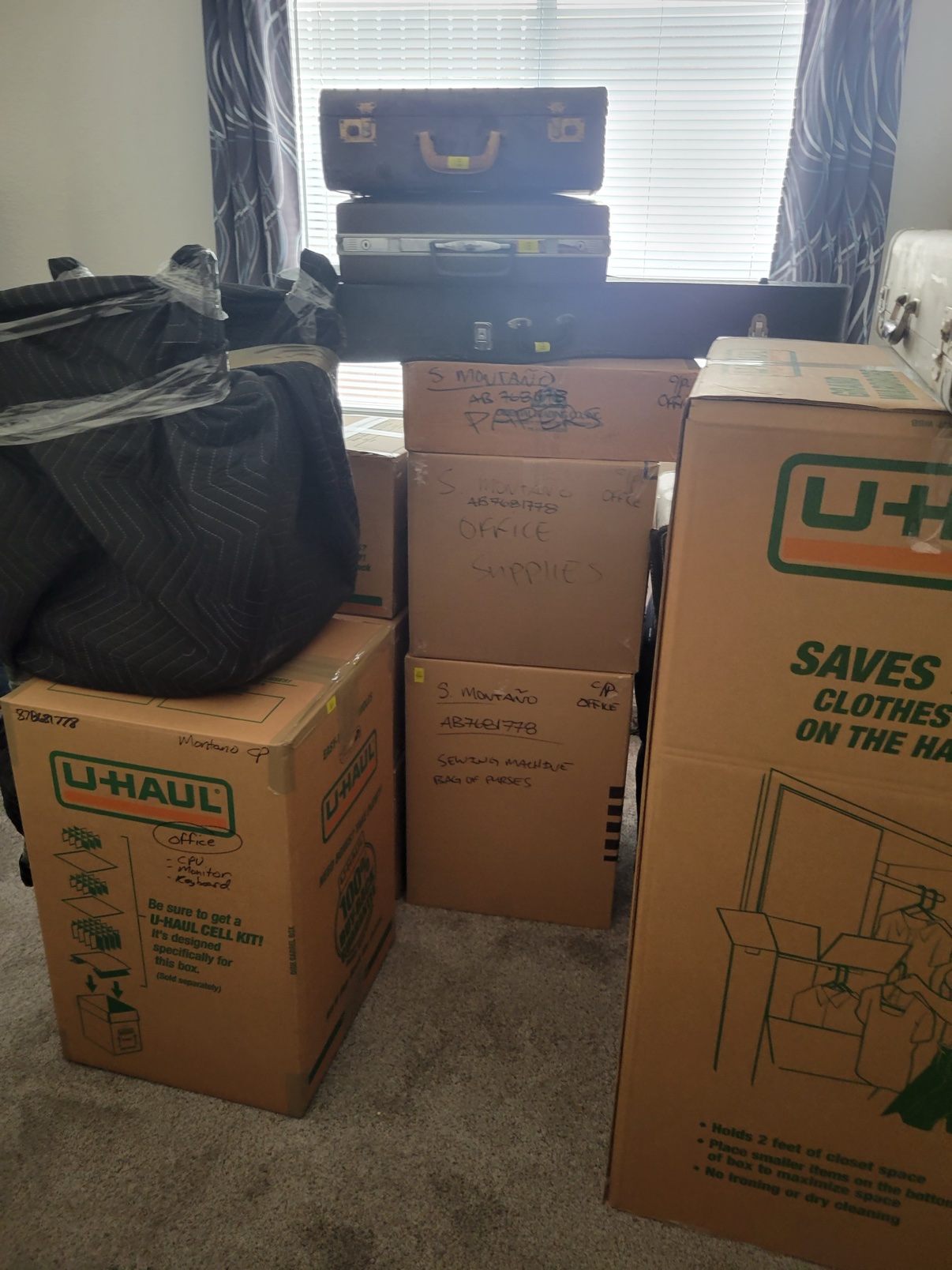
Suitcases, office boxes, wardrobe
Suitcases stacked by the window, office boxes labeled with their contents, and a U-Haul wardrobe box standing ready for the closet.
Even the bathroom, binned and stacked
Clear bins taped shut and stacked in the bathroom — every room gets packed, right down to the last shelf of toiletries.
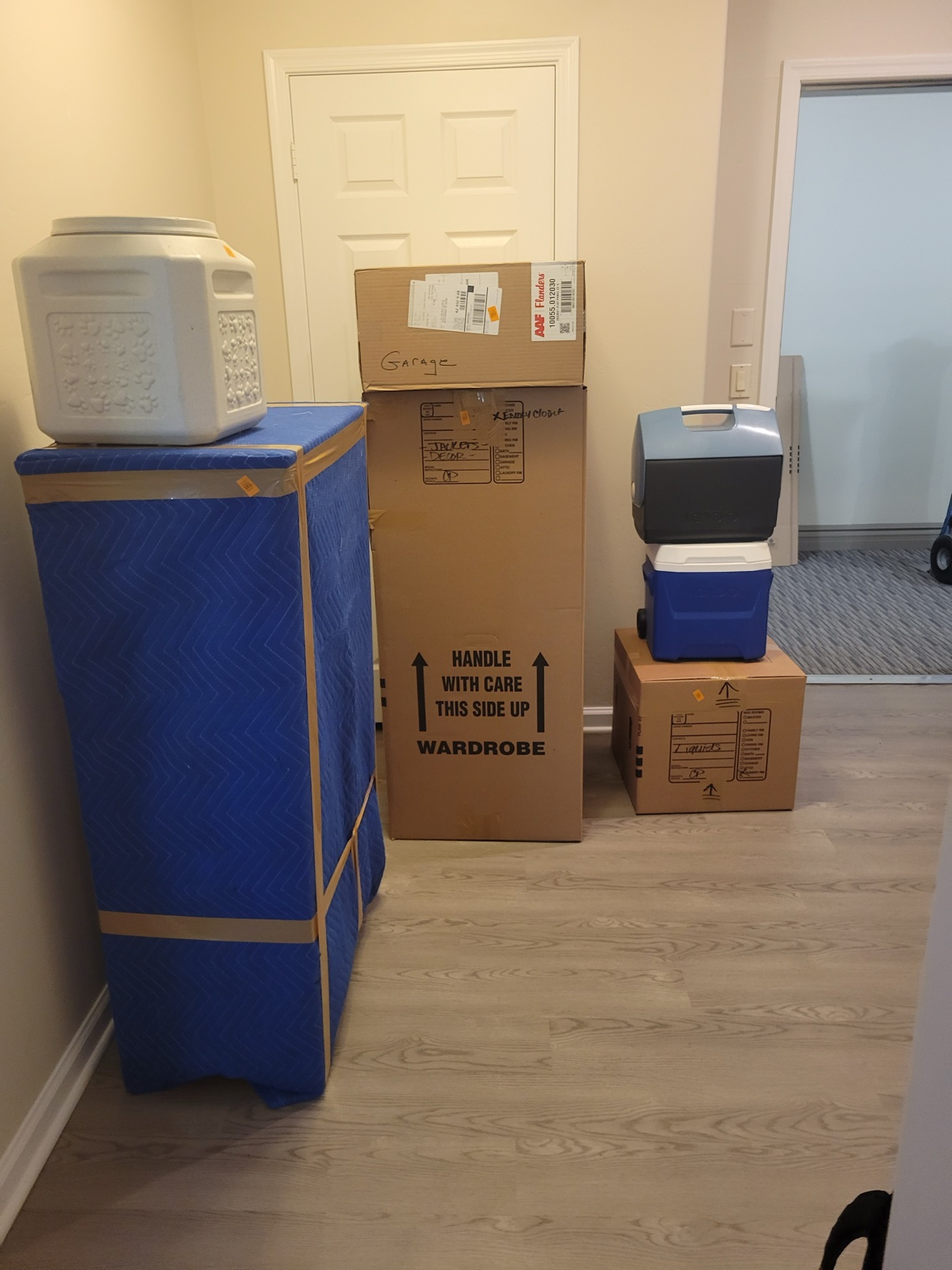
Wardrobe box, wrapped furniture, coolers
A wardrobe box standing tall, furniture pad-wrapped in blue, and the coolers stacked on a box — packed and waiting for the load.
The first six photos are from real jobs posted by @ez_da_hauler on Instagram; the rest are EZ Moving & Hauling's own job photos from real moves, most of them truck 8006. Work photos only — trucks, loads, and job sites.